


Story Notes
He strode to the flybridge, grabbing the powerful binoculars from their bracket. He raised them to his eyes, the world snapping into hyper-focused detail. The pebbles on the beach became individual stones. He could see the veins on the oleander leaves.
He trained the glasses on the shape.
And the world stopped.
It was not a sail. It was not rags.
It was a body.
A human body. A woman’s body.
Summary
When Jure, a wealthy 57-year-old businessman, discovers a naked, unconscious young woman in a hidden cove near Dubrovnik, he brings her to his luxury villa. The girl—who remembers nothing—awakens with extraordinary violet eyes and an otherworldly innocence. Jure names her Mirna and becomes dangerously obsessed with her fragile beauty. As her dependence on him grows, his possessiveness turns into control, desire, and finally unwanted touch, trapping her in a gilded cage.
1 The Prologue
She dragged herself onto the sun-warmed pebbles of the beach, her body aching, her consciousness already receding. The white stones were smooth and cool against her feverish skin. She curled onto her side, one arm outstretched towards the water as if to maintain the connection. The last thing she felt was the gentle lap of the waves kissing her fingertips. The last thing she saw was the perfect, unbroken blue of the sky above the cove.
Then, nothing. A profound, absolute nothing. The deep sleep of her kind had taken her, a protective coma to allow for healing and change. The scratches on her skin glistened in the sun. The dark bruise on her shoulder bloomed like a strange flower against her pallor. Her long, curly hair fanned out around her, a dark-gold halo on the white stones.
She was utterly vulnerable, stranded at the edge of two worlds, her song silenced, her power dormant. She did not hear the approaching, silent yacht. She did not see the tall, broad-shouldered man standing at its helm, his sharp, whiskey-colored eyes scanning the beach, widening in shock and then narrowing with a dark, possessive curiosity. She did not feel his shadow fall over her as he waded ashore, or his hands, rough and claiming, as they lifted her from the sanctuary she had fought so desperately to reach.
The sea, her mother and her home, could only watch, its waves sighing a lament against the shore as its daughter was taken…

2 The Discovery
The sun, a merciless disc of hammered gold, reigned supreme in a sky bleached of all mercy. It beat down upon the Adriatic, transforming the sea into a vast, shimmering plain of liquid sapphire and turquoise. On the deck of the Sirena, a sixty-five-foot masterpiece of teak and gleaming white fiberglass, Jure Barišić felt the sun’s gaze like a physical weight, a familiar pressure he had long ago learned to ignore. At fifty-seven, his face was a testament to that enduring indifference; it was a landscape of leathery, sun-cured skin, cross-hatched with the fine lines of squinting into a thousand horizons and creased with the deeper grooves of decisions that had broken lesser men. His hair, a thick, silvered mane, was swept back from a forehead that seemed perpetually set in a slight, calculating frown. His eyes, the colour of old whiskey, held a flinty sharpness that missed nothing—the shift of the wind on the water, the subtle flicker in a business associate’s gaze, the precise value of everything he surveyed.
And he surveyed a great deal.
The Sirena cut through the water with a low, powerful hum, a sound that was the very heartbeat of his solitude. He stood at the helm, his large, capable hands resting lightly on the polished wheel. He was a man built of solid, uncompromising stock, his frame still powerful beneath his crisp, white linen shirt, which was open at the neck, revealing a glimpse of sun-browned chest and a simple gold chain. The air was thick with the smells he loved most: the salty tang of the sea, the faint, clean scent of diesel, and the rich aroma of teak oil.
He was escaping. It was a ritual, this solo voyage down the Dalmatian coast. It was a temporary abdication from the throne of his own making—Barišić Holdings, a sprawling empire of shipping, tourism, and real estate that had its tentacles deep in the flesh of the new Croatia. In Dubrovnik, in Split, in Zagreb, his name was spoken with a mixture of respect, envy, and fear. He was a king, but his crown was heavy, forged in the chaotic fires of the post-Yugoslavia years, a time when fortunes were made not by the faint of heart, but by those willing to grasp opportunity with both hands, no matter how bloodied they became. His conscience, once a flickering candle, had been snuffed out decades ago by the relentless winds of pragmatism. What remained was a cool, calculating emptiness, a void he tried to fill with acquisitions, with victories, and on days like this, with the vast, impersonal beauty of the sea.
He was heading for a place he thought of as his own. Not on any deed, not marked on any public chart, but his by right of discovery and by the simple, unassailable fact that he was the only one who ever went there. It was a cove, a tiny, almost imperceptible incision in the rugged coastline south of Dubrovnik, accessible only by a narrow, treacherous channel known only to a handful of local fishermen too old to care and to Jure, who had paid one of them a small fortune in cash for the secret twenty years ago.
He nudged the throttles, the engines responding with a deeper-throated growl. The coastline here was a dramatic spectacle of nature’s brutal architecture. Limestone cliffs, bone-white and sheer, plunged into water of such impossible, luminous blue it seemed to be lit from within. The pines clung to the rock faces with tenacious roots, their dark green a stark contrast to the blinding white and blue. It was a landscape that tolerated no softness, and Jure felt a kinship with it.
He approached the entrance to the channel, a mere slit in the cliff face that from the open sea looked like a solid, impenetrable wall of rock. It was a navigational nightmare, a gauntlet of submerged, razor-sharp rocks that could gut a hull in seconds. He had memorized the path, a serpentine dance of slight turns and aligned landmarks. A single, lightning-blasted cypress tree on the eastern ridge had to kiss the tip of a distant, pyramid-shaped islet. A specific, rust-coloured stain on the cliff face had to be directly amidships.
His whiskey-coloured eyes narrowed, focusing completely. This was a part of the ritual he enjoyed—the concentration, the absolute demand for precision. It was a clean, simple problem with a clear, binary outcome: success or catastrophic failure. Unlike the problems of his business life, which were always murky, fraught with human unpredictability and legal ambiguities.
He took a slow, deliberate breath, the salt air filling his lungs. He cut the engines back to a bare idle, and the Sirena ghosted forward, nudged by the gentle swell. The shadow of the cliffs fell over him, cool and abrupt. The sound of the sea changed, from the open-water slap of waves against the hull to a softer, echoing lap against the confined stone walls. He was in the channel. It was so narrow he could almost reach out and touch the damp, barnacled rock on either side. The water here was darker, a deep, mysterious green. Sunlight only penetrated in scattered, shifting coins of light that danced on the stone.
For five tense minutes, he guided the yacht through the labyrinth, his hands making minute adjustments on the wheel. Then, the channel widened abruptly, and he was through.
The cove.
It was as perfect as he remembered. A near-circular bowl of water, perhaps two hundred yards across, so still and protected it was like a liquid mirror. The surface was a flawless, unbroken sheet of glass, reflecting the cliffs and the perfect, cerulean sky with such fidelity that the line between reality and reflection blurred. At its heart, the water deepened to a profound, luminous violet-blue, a colour that seemed to suck the light in and hold it deep below. Around the edges, over a bed of pure white pebbles, it shifted to a transparent, glowing turquoise. A small, crescent-shaped beach of those same white pebbles nestled at the far end, backed by a thicket of oleander and myrtle, their pink and white blossoms filling the still air with a heavy, cloying perfume.
The silence was absolute, broken only by the gentle, metallic creak of the Sirena’s hull and the distant, lonely cry of a gull high above the cliffs. This was it. His sanctuary. The one place on earth where the weight of being Jure Barišić seemed to lift, if only for a few hours. Here, there were no sycophants, no rivals, no memories of a failed marriage, no ghost of a son whose gentle nature felt like a personal reproach. There was only the sun, the stone, and the sea.
He killed the engines. The sudden silence was profound, a physical presence that settled over the cove. He walked to the stern, his deck shoes making soft, sure sounds on the teak. He prepared to drop the anchor, the chain rattling in the stillness like a burst of gunfire before it plunged into the depths, the rope running through his hands with a familiar, rough warmth.
It was then, as the boat settled, swinging gently on its anchor line, that his eyes, scanning the perfect crescent of the beach as they always did, caught the anomaly.
A splash of colour.
Not the bright pink of the oleander or the green of the foliage. Something paler. Something… organic.
He froze, his hand still on the anchor line. A jolt of pure, undiluted anger flashed through him. An intruder. Someone had found his place. Campers? Tourists on a stolen dinghy? His jaw tightened. He would have them removed. He would buy the entire headland if he had to. He would…
He squinted, his sharp eyes trying to resolve the shape. It was lying at the water’s edge, where the gentle lap of the waves kissed the white pebbles. It was long, and… formless. A discarded sail? A bundle of rags?
He strode to the flybridge, grabbing the powerful binoculars from their bracket. He raised them to his eyes, the world snapping into hyper-focused detail. The pebbles on the beach became individual stones. He could see the veins on the oleander leaves.
He trained the glasses on the shape.
And the world stopped.
It was not a sail. It was not rags.
It was a body.
A human body. A woman’s body.
She was lying on her side, facing the water, one arm outstretched as if reaching for the sea. And she was utterly, completely naked.
The breath caught in Jure’s throat. The binoculars felt heavy in his suddenly numb hands. He adjusted the focus, his heart now hammering against his ribs, a frantic, wild rhythm that was entirely alien to him.
Her skin was pale, almost luminous against the white pebbles and the deep tan of his own arms. It was crisscrossed with faint, pink scratches, as if she had been dragged through the thorny maquis that covered the cliffs. Her hair was a wild, tangled mane of dark blonde, shot through with lighter streaks of gold and honey, curls matted with sand and salt, fanning out around her head like a bizarre, sun-bleached halo. Even from this distance, through the lenses, he could see the elegant line of her spine, the gentle curve of her hip, the long, slender length of her legs.
She was not moving.
A thousand thoughts, cold and practical, fought for dominance in his mind. A drowning. A suicide. A murder victim dumped from a boat. This was a complication. A problem. It meant police, questions, paperwork, the vile stench of scandal. His name in the tabloids. Wealthy Businessman Finds Naked Body on Secret Cove. He could already see the headlines.
He should turn around. Right now. Start the engines, pull up the anchor, and leave. Sail back to Dubrovnik and report it anonymously from a payphone. Let someone else find her. It was the smart thing to do. The clean thing.
But he didn’t move.
He was transfixed. There was a profound, unsettling vulnerability to the scene. The utter nakedness, the solitude, the way she seemed both a part of the landscape and a terrible violation of it. It was like stumbling upon a secret the sea had coughed up and then forgotten.
He lowered the binoculars. The silence of the cove was no longer peaceful. It was oppressive, watchful. The cliffs seemed to lean in, waiting to see what he would do.
“Damn it,” he muttered, the curse ripped from him.
He moved with a sudden, decisive energy. He went below deck, grabbing the large, Turkish towel from the head, and a first-aid kit, more out of habit than any real hope. He kicked off his deck shoes, not wanting to fill them with water, and climbed down the swim ladder at the stern, the cool water soaking his linen trousers instantly, clinging to his calves.
He waded ashore, the white pebbles shifting and crunching under his bare feet. The water was shockingly cold, a stark contrast to the sun-warmed air. With each step, the woman’s form became clearer, more real, more terribly human.
He stood over her, his shadow falling across her pale skin.
Close up, she was even more of a shock. She was young, perhaps in her early twenties. Her body was a masterpiece of youthful grace—slender, but with the soft, rounded curves of womanhood. The scratches on her skin were superficial, but numerous. A dark bruise was blooming on her shoulder. Her face, half-buried in the curtain of her hair, was possessed of a delicate, almost unreal beauty. High cheekbones, a straight, fine nose, lips that were full and pale.
He knelt beside her, the pebbles digging into his knees. He reached out, his fingers, usually so steady, trembling slightly. He pressed them against the side of her neck, just below the jawline, feeling for a pulse.
For a terrifying second, he felt nothing. Just the cool, smooth skin.
Then, a faint, thready flutter. A fragile rhythm of life, so weak it felt like it might vanish with his next breath.
She was alive.
The relief that washed through him was immediate and surprisingly powerful, followed instantly by a new wave of complication. An alive woman was a different category of problem altogether.
“Hello?” he said, his voice rough, unnaturally loud in the silence. “Can you hear me?”
There was no response. Not a twitch. Her unconsciousness was absolute.
He had to get her out of here. The sun, while not directly on her now, would soon move across the cove. She was exposed, vulnerable. He unfolded the large towel, its thick, soft cotton a stark contrast to the harshness of the pebbles. How to move her? He was a strong man, but she was a complete unknown. A limp body was awkward, heavy.
He slid one arm carefully under her knees, the other under her shoulders. Her skin was cool, but not deathly cold. As he lifted her, her head lolled back against his arm, her hair falling away from her face completely.
He froze, staring.
In the shadow of the cliffs, her face had been pale and beautiful. Now, in the full, unfiltered light of the cove, it was something else entirely. It was the face of a myth, a face that belonged on a fresco or a ancient coin. But it was her utter helplessness that struck him most deeply. Here was a creature of such rare and delicate beauty, utterly broken and abandoned. A priceless vase shattered on the shore.
A possessive instinct, primal and deep, stirred within him. It was the same instinct that had driven him to acquire companies, properties, and artworks he didn’t need. The instinct to take something of value and make it his. This was not a person to him in that moment; she was a discovery. A treasure. His treasure.
He wrapped the towel around her as best he could, covering her nakedness, a gesture that felt oddly proprietary rather than protective. He lifted her fully. She was surprisingly light, as if her bones were hollow, like a bird’s. She made a small, soft sound, a mere exhalation, but it was not a sound of waking. It was the sound of deep, profound oblivion.
Carrying her, he waded back into the water. It was harder going now, with the weight in his arms and the pebbles shifting under his feet. The water soaked him to his waist. He reached the swim ladder and the real challenge began. He couldn’t climb with her in his arms.
He laid her over his shoulder in a fireman’s carry, her torso hanging down his back, his arm clamped firmly around her legs. The towel slipped, and the cool, smooth skin of her thigh was against his cheek. He gritted his teeth, focused on the task. He climbed, the ladder groaning under their combined weight. He hauled them both over the stern rail and onto the deck, collapsing for a moment on the warm teak, breathing heavily, the woman sprawled limply beside him.
He looked down at her, at the tangled hair stuck to her damp face, the pale, vulnerable length of her sprawled on his deck. On his boat. A strange, unsettling thrill ran through him. He had taken her from the sea. He had claimed her.
He stood up, his decision made. There would be no police. Not yet. Not until he understood what he had found.
He lifted her again, more easily now, and carried her down the few steps into the master cabin. The room was cool, paneled in rich, honey-coloured wood, the large bed neatly made with crisp, white linen. He laid her on the bed, the towel falling away. He didn’t try to cover her again. He just stood there, looking.
The cabin’s soft, indirect lighting seemed to worship her. It highlighted the delicate architecture of her collarbones, the gentle swell of her breasts, the narrow waist, the dark blonde triangle of hair at the junction of her thighs. She was a statue of alabaster and gold, a piece of living art.
He became aware of his own breathing, harsh and loud in the quiet cabin. He became aware of a tightness in his gut, a coiling of desire so immediate and so potent it shocked him. It had been years since he had felt such a raw, untempered hunger. It was not tender. It was not loving. It was the desire of a collector for his prize, of a conqueror for his spoils.
He forced himself to turn away. He pulled the white duvet over her, covering her from neck to toe. The act felt like sealing something in a crate.
He returned to the deck, his wet trousers clinging unpleasantly to his skin. The cove no longer looked like a sanctuary. It looked like a crime scene. Or a birthplace. He wasn’t sure which.
He moved to the helm, his movements brisk and efficient. He started the engines, the powerful rumble once again shattering the silence. He went forward and hauled the anchor back aboard, the chain clattering and dripping, the rope coiling in a wet, heavy heap.
He took one last look at the beach, at the indentation in the pebbles where she had lain. The sea had already erased any other sign of her. It was as if she had never been there.
But she had. And now she was his.
He pushed the throttles forward. The Sirena turned her prow towards the channel, towards the open sea, towards Dubrovnik. Towards home. Jure Barišić stood at the wheel, his face a mask of grim determination, his whiskey-coloured eyes fixed on the narrowing slit in the cliffs. Behind him, in the cool, dim silence of his cabin, the sea’s lost daughter slept on, unaware that her rescue was merely the first link in a new, golden chain.

3 The Unconscious Guest
The channel out of the cove felt different. The narrow passage of rock, once a gateway to solitude, now felt like a gauntlet he was running, a fugitive fleeing a crime scene. Jure’s hands were locked on the teak wheel, his knuckles bone-white. The Sirena’s engines, usually a sound that spoke of freedom and power, now roared with the frantic urgency of a getaway car.
His mind was a storm of conflicting impulses, a battlefield where cold pragmatism warred with a strange, burgeoning obsession. Every few seconds, his eyes would flick from the treacherous, razor-edged rocks to the companionway that led below deck, as if expecting her to appear. But she didn’t. The only evidence of her presence was the profound, unsettling silence from his master cabin, a silence that felt heavier and more significant than any sound.
The hospital. The thought was a clear, logical beacon in the chaos. The General Hospital in Dubrovnik was competent, clean. He could have her there in under an hour. He would be the good Samaritan, the wealthy benefactor who’d done his civic duty. There would be forms, questions from polite but firm doctors and perhaps a bored police constable. Where did you find her? Was there anyone else? Did you see a boat? He could answer them. He was Jure Barišić. His word was a solid, unassailable thing. They would nod, thank him, and take her off his hands.
And then what?
She would become a case number. A Jane Doe in the system. Her extraordinary, fragile beauty would be subjected to the harsh, fluorescent lights of a public ward, the prodding of strangers, the bureaucratic indifference of the state. The image of her, lying on that white bed in his cabin, was seared onto his retina. She was a rare, priceless artifact, washed up on a forgotten shore. Handing her over to the authorities felt like dropping a newly discovered Da Vinci into a government warehouse. It was an act of supreme carelessness.
And there was more. A darker, more possessive thread woven through his reasoning. If he took her to the hospital, she would cease to be his. The mystery of her would be taken from him, dissected by others. The singular, electrifying moment of his discovery would be diluted, turned into a mundane anecdote for a police report. He had pulled her from the sea. He had felt the faint, bird-like flutter of her pulse beneath his fingers. He had carried her, her cool skin against his. That created a bond, a primal claim that logic could not dissolve.
He bypassed the main shipping lane, keeping the yacht close to the dramatic, sheltering coastline. The ancient walled city of Dubrovnik came into view in the distance, a fairy-tale citadel of orange-tiled roofs and formidable stone walls glowing in the late afternoon sun. It was a postcard view, a symbol of order and civilization. He turned away from it, guiding the Sirena south, towards the secluded headland where his villa perched like a raptor’s nest.
His villa. Kameni Orkan—The Stone Hawk. He had named it himself. It was not a home; it was a statement. A fortress of modernism and steel grafted onto the ancient limestone cliffs, all sharp angles, floor-to-ceiling glass, and cantilevered terraces that thrust out over the abyss. It was accessible only by a single, gated road that wound its way down from the coastal highway, or by sea. It was the ultimate expression of his success and his isolation. A place where he was utterly in control.
As he approached the private dock, a sleek, concrete structure extending from a small, man-made inlet, he reached for his phone. He had a single, dedicated speed-dial number.
It was answered on the second ring. “Gospodin Barišić?” The voice was a familiar, steady alto, laced with a quiet, unflappable competence.
“Lena,” he said, his voice tighter than he intended. “I am arriving at the dock now. I have… a guest. She is unwell. I will need your help.”
There was the briefest of pauses on the other end. Not of hesitation, but of processing. “Of course, sir. What kind of help?”
“She is unconscious. She will need to be carried. And prepared a room. The… the south guest room. With the sea view.”
“The south guest room,” she repeated, her tone neutral, yet he could almost hear the gears turning in her head. The south guest room was the finest in the villa, reserved for his most important—or most favored—business associates. It had its own terrace, a marble en-suite, and a view that stole the breath from your lungs. He had never put a sick, unknown “guest” in there.
“We will be up in five minutes,” he said, and ended the call.
He maneuvered the Sirena with a surgeon’s precision into its berth, the fenders groaning softly against the dock. The silence that descended when he killed the engines was once again profound. Now, it was filled with the weight of the decision he had just irrevocably made.
He went below.
She hadn’t moved. She lay exactly as he had left her, a pale sculpture beneath the white duvet. Her hair was a wild, drying aureole on the pillow, the dark blonde strands beginning to separate into individual, coppery curls. In the cabin’s soft light, her skin seemed less like alabaster and more like living pearl, with a subtle, inner luminescence. He stood over her, just looking, for a full minute. The desire to touch her again, to confirm the reality of her, was a physical pull. He resisted. This was not the time.
He re-wrapped her in the large Turkish towel, ensuring she was fully covered, a bundle of pristine white cotton from which only her face and a cascade of tangled hair emerged. The act felt ritualistic, like swaddling an infant or preparing a sacred object for transport. Lifting her, he was once again struck by her lightness. It was unnatural, unsettling. She was all air and spirit, with no substance.
He carried her up onto the deck, the late afternoon sun warm on his back. The climb from the dock to the villa was a steep one, a series of wide, stone steps carved into the cliff face, flanked by cypress trees and agave plants. He saw a figure waiting at the top.
Lena Petrović stood, a solid, immovable silhouette against the brilliant sky. She was a woman in her late sixties, with a face that was a roadmap of a life lived with dignity and quiet strength. Her grey hair was pulled back in a severe bun, and she wore a simple, dark dress. She had been his housekeeper for fifteen years, since his divorce. She was more than staff; she was a fixed point in his turbulent universe, a woman who had seen his triumphs and his rages and had never once judged him aloud. Her loyalty was absolute, her discretion, priceless.
As he ascended the final steps, her sharp, dark eyes took in the scene in a single, comprehensive glance: her employer, his linen trousers soaked and clinging, his face a mask of grim intensity, carrying a limp, towel-shrouded form in his arms. Her lips tightened almost imperceptibly, but she said nothing. She simply moved aside to let him pass, then fell into step behind him as he moved through the villa’s vast, minimalist living area.
The villa was a temple to his taste—cool, expensive, and impersonal. Polished concrete floors, white walls, furniture that was more architectural statement than comfort. Massive artworks, abstract and severe, dominated the spaces. It was a place designed to impress and to intimidate, not to nurture.
He carried his burden down a wide, airy corridor to the south wing. The door to the guest room was open. Lena had been efficient; the blinds were raised, flooding the room with the golden, late-afternoon light, and the sheets on the vast, low-slung bed were turned down.
“Lay her here,” Lena said, her voice calm and practical.
Gently, far more gently than he did most things, Jure laid the woman on the crisp, white linen. The towel fell open slightly, revealing a pale shoulder and the curve of her neck. Lena’s eyes darted to the exposed skin, to the faint scratches, then back to Jure’s face. The question hung, unspoken, in the air between them.
“I found her,” Jure said, the explanation sounding inadequate even to his own ears. “In the cove. On the beach. She was like this.”
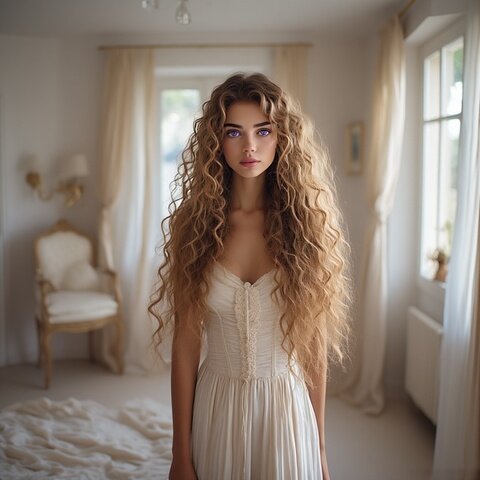
Lena moved to the bedside. She did not gasp or exclaim. Her reaction was a subtle, controlled intake of breath, a slight widening of her eyes. She was looking at the woman’s face, at the impossible, sculptural beauty, the dusting of freckles across the bridge of her nose, the dark, silken sweep of her lashes against her cheeks.
“She is breathing,” Lena observed softly, her professional demeanor reasserting itself. She reached out, her work-roughened fingers far more confident than Jure’s had been, and felt for the pulse at the woman’s wrist. “Steady. But weak. Gospodin Barišić, she needs a doctor.”
“No,” Jure said, the word coming out sharper than he intended. He moderated his tone. “Not yet. She is stable. She just needs to rest. In a proper bed. Not in some… public ward.”
Lena’s gaze was unwavering. She understood the subtext. No outsiders. No questions. This stays here. She had worked for him long enough to know that Jure Barišić’s world was one of controlled narratives and managed perceptions. A naked, unconscious woman was a variable that could not be controlled.
“She is injured,” Lena stated, her eyes tracing the scratches on the woman’s arms and legs. “There is a bruise here, on her shoulder. We should at least clean these.”
“You can do that,” Jure said. It was not a question.
Lena gave a single, slow nod. “I can. But I am not a doctor.”
“We will watch her. If she does not wake soon, or if she seems worse… then we will reconsider.” It was a concession, however hollow.
Another silence stretched between them, filled only by the soft, rhythmic sound of the woman’s breathing. Lena finally broke it. “We cannot leave her like this.” She gestured to the towel. “It is damp from your clothes. She will catch a chill. She needs to be properly cleaned and put into something dry.”
Jure felt a strange, proprietary reluctance. The towel was the last connection to the moment of discovery, to the raw, unmediated truth of her on the beach. To remove it was to begin the process of domesticating her, of fitting her into his world. But Lena was right.
“Do it,” he commanded, his voice gruff. He turned and walked to the wall of glass that looked out over the terrace to the sea. He stood with his back to the bed, his hands shoved into his pockets, a sentinel facing the horizon. He heard the soft, efficient sounds of Lena’s movements behind him: the rustle of the towel being removed, the opening of a wardrobe, the running of water in the en-suite bathroom.
He stared out at the vast, empty expanse of the Adriatic. The sea that had given her to him. What was her story? A shipwreck? There had been no storms. A pleasure boat accident? No reports of anything missing. A suicide attempt? She seemed too… vital, even in her unconscious state, for that. An assault? The thought sent a cold, dark fury through him. Had someone harmed her and thrown her overboard? The idea that someone else had laid claim to her, had violated that perfect form, was intolerable.
“Gospodin Barišić.”
He turned. Lena had worked quickly. The woman was now dressed in one of the simple, expensive cotton nightdresses that were kept in the guest room drawers. It was white, long-sleeved, and high-necked, making her look even more like an innocent, a sleeping angel. Her hair had been brushed back from her face, the wild tangles smoothed into waves that flowed over the pillow. Lena had washed the sand and salt from her skin, and the superficial scratches now stood out, thin, pink lines against her pristine pallor. She looked peaceful, curated, and utterly, heart-stoppingly beautiful.
“She has no… marks,” Lena said quietly, answering the question he had not dared to ask aloud. “Nothing serious. The scratches are only on the surface. The bruise is the worst of it. She is… unblemished.”
Unblemished. The word echoed in the quiet room. It was the right word. She was a perfect canvas.
“Thank you, Lena,” he said, his voice low.
“What shall we call her?” Lena asked, her practical mind already moving to the next necessity. “We cannot just call her ‘her’.”
Jure’s eyes drifted from the woman’s face to the window, to the sea. The sea that was both serene and deep, mysterious and powerful. The sea that had hidden her and then revealed her to him.
“Mirna,” he said, the name coming to him as if from the water itself. “We will call her Mirna.”
It was a common enough Croatian name, meaning ‘peaceful’ or ‘serene’. But it also evoked the mirno more—the peaceful sea. It was perfect. It tied her to this place, to his world, to the element that had delivered her to him.
Lena nodded slowly. “Mirna,” she repeated, testing the sound. “It suits her.” She moved towards the door. “I will prepare some broth. In case she wakes. And I will find some salve for these scratches.”
She left, closing the door softly behind her, leaving Jure alone with the woman who was now Mirna.
The room was bathed in the deep, honeyed light of the setting sun. The sky was beginning to flame into oranges and purples, and the first star, Venus, glittered like a diamond just above the horizon. The scene was one of impossible romance, a cliché from a film. But the reality in the room was far stranger, far more potent.
He pulled a heavy, leather armchair close to the bed and sat down. He did not touch her. He simply watched. He watched the barely perceptible rise and fall of her chest beneath the white cotton. He watched the flicker of a tiny muscle beneath her eye. He watched the way the dying light gilded the tips of her eyelashes and painted her lips a softer, rosier hue.
He was a hunter, and he had captured the most exquisite prey. He was an archaeologist, and he had unearthed a priceless relic. He was a king, and a new, mysterious subject had been delivered to his court.
The rational part of his mind, the part that had built an empire, knew this was insanity. It whispered of liability, of danger, of the monstrous ego required to make such a decision. But that voice was faint, distant, like the cry of a gull from far away.
A stronger, deeper current was pulling him now. A current of possession, of fascination, of a desire that was as much about the mystery as it was about the flesh. He had bypassed the hospital. He had brought her here. He had named her.
The chain of ownership was being forged, link by deliberate link.
Outside, the sun finally dipped below the horizon, and the room was plunged into a soft, blue twilight. Jure Barišić did not move to turn on a light. He sat in the growing darkness, a silent, brooding sentinel watching over his impossible, sleeping prize. The villa was silent, the world was shut out, and the only thing that was real was the faint sound of her breathing and the vast, dark, unknowable sea beyond the glass.

4 The Girl Without a Past
The dusk did not so much fall as it rose, seeping up from the deep troughs of the sea to bleed the vibrant colours from the sky. The fiery oranges and passionate purples of the sunset cooled to a wash of deep indigo and bruised lavender, a perfect, silent backdrop to the room. Jure had not moved for hours. The leather armchair had molded to his form, a testament to his vigil. A single, low-wattage lamp in the corner cast a soft, golden pool of light that lapped at the foot of the bed but left Mirna’s face in a realm of shifting shadows and twilight.
He had watched the minute changes in her throughout the afternoon. The subtle shift from a death-like stillness to a more natural repose. A slight twitch of a finger, a soft, sighing exhalation that was different from the shallow, mechanical breaths of before. Lena had come and gone twice, once with a bowl of lukewarm chicken broth that now sat untouched and congealing on the bedside table, and once with a jar of calendula salve, with which she had gently anointed the scratches on Mirna’s arms and face. Jure had waved her away on both occasions, his silence a command to leave him to his watch.
His mind had been a whirlpool, circling the same unanswerable questions. Who was she? What cataclysm had deposited her, naked and alone, on his shore? The practicalities of her continued presence began to assert themselves. He would need a story for anyone who asked. A distant, unfortunate relative from a war-torn region, perhaps, traumatized into silence. He had the resources and the influence to forge documents, to create a plausible backstory. Mirna. The name was settling in, becoming real. She was no longer “the woman”; she was Mirna, his creation, his charge.
He leaned forward, elbows on his knees, studying her in the dim light. The salve had given her skin a slight sheen, making it look like polished marble. The simple white nightdress, so stark and pure, heightened her otherworldliness. She was a figure from a pre-Raphaelite painting, a sleeping beauty under a spell. He felt the strange, tight knot of desire and possession in his gut tighten another degree. It was a feeling more complex than mere lust. It was the awe of a collector who has finally acquired his masterpiece, the terrifying thrill of a scientist on the verge of a world-altering discovery.
It was then that he saw it. A change in the rhythm of her breathing. A slight, almost imperceptible hitch, a deepening intake of breath. Her eyelids, which had been perfectly still for so long, fluttered. Not the random, unconscious twitches of deep sleep, but a deliberate, struggling motion, as if they were weighted down with lead.
Jure froze, his own breath catching in his chest. He straightened up in the chair, his heart beginning a slow, heavy thud against his ribs. This was the moment. The veil was about to be lifted.
Her eyes opened.
It was not a sudden, startled awakening. It was a slow, dawning, like the moon emerging from behind a cloud. First one, then the other. They were unfocused, bleary with the residue of whatever profound oblivion had held her.
And then they focused on him.
Jure felt the air leave his lungs in a silent, involuntary rush. It was a physical sensation, a punch to the solar plexus that had nothing to do with impact and everything to do with revelation. He had thought her beautiful in sleep, but that was a dormant, potential beauty. This was alive. This was conscious.
Her eyes.
They were the most extraordinary things he had ever seen. Large, slightly almond-shaped, and set wide apart, they dominated her pale, delicate face. But it was the colour that stole all reason, that rendered him momentarily mute. They were not blue, not grey, not hazel. They were a clear, startling, and utterly impossible shade of violet. A deep, luminous amethyst, flecked with tiny shards of silver around the pupils that caught the faint light in the room and seemed to give off a light of their own. They were the colour of the twilight sky over the Adriatic, of the rarest, most precious gems locked away in royal vaults. They were ancient eyes, deep and knowing, yet in this moment, they were filled with a raw, primal, and utterly devastating fear.
It was the fear of a wild animal caught in a trap, of a creature waking in a cage. It was a fear so pure and unguarded that it was almost a physical force in the room.
For a long moment, they simply looked at each other. Jure, the powerful, worldly man, rendered speechless by a pair of eyes. Mirna, the ethereal mystery, trapped in a waking nightmare she did not understand.
Her lips, pale and dry, parted. A small, ragged sound escaped, little more than a whisper of air. Then, she found her voice. It was raspy, cracked from disuse and dehydration, a ghost of a sound that was nonetheless perfectly clear in the profound silence of the room.
“Who are you?”
The three words were spoken in Croatian. Flawless, unaccented, native Croatian. The shock of it was almost as profound as the shock of her eyes. He had, without realizing it, prepared himself for a foreigner, for someone who spoke English or Italian or some other language of the tourist-laden sea. But this… this tied her to this land, to his world, in a way he had not anticipated. She was one of his own. The mystery deepened, becoming more intimate, more tangled.
He leaned forward, careful not to make any sudden movements that might shatter the fragile moment. He kept his hands visible, resting on his knees, trying to project an aura of calm authority, of safety.
“You’re safe,” he said, and was surprised to hear how soft his own voice was, stripped of its usual command and edged with a gentleness he hadn’t known he possessed. It was a tone he might use with a skittish horse or a valuable, fragile object. “My name is Jure. Jure Barišić. I found you.”
Her violet eyes darted around the room, taking in the high, shadowed ceiling, the vast window with its view of the now-dark sea, the expensive, minimalist furniture. There was no recognition there, only a deepening confusion that fed the fear. This was not a familiar place. This was another layer of the nightmare.
“Where… where am I?” The rasp was still there, but a little stronger now, laced with a rising panic.
“You are in my home,” Jure said, his voice a low, steady drone, meant to soothe. “On the coast. Near Dubrovnik. You were… on a beach. You were hurt. I brought you here.”
He watched her process this. He saw the struggle in her magnificent eyes, the frantic searching through a void where memory should be. She was trying to access a file that was not there. Her brow, smooth and pale, furrowed slightly. She tried to push herself up on her elbows, but a wave of weakness overcame her, and she sank back into the pillows with a soft gasp of frustration and fear. The movement caused the neck of her nightdress to shift, and he saw the dark, ugly bruise on her shoulder more clearly. Her eyes followed his gaze, and she looked at the bruise as if seeing it for the first time, her confusion deepening.
“I found you,” he repeated, anchoring her to the one solid fact he could provide. “Do you remember anything? The sea? A boat? Anything before you woke up here?”
He held his breath. This was the crucial question. The answer would define everything that was to come.
Her eyes, wide and terrified, locked back onto his. She searched his face, as if trying to find the answer written there. He saw the hope flicker, a desperate need to grasp onto something, anything. He saw the internal struggle, the frantic sifting through the empty shelves of her mind. A single, perfect tear welled up in the corner of her left eye, clinging to the thick, dark lashes for a heart-stopping moment before tracing a slow, silvery path down her temple and into her hairline.
It was a tear of pure, unadulterated despair.
Her lips trembled. She opened her mouth to speak, closed it, then tried again. The word that emerged was a whisper of profound loss, a surrender.
“No.”
The single syllable hung in the quiet room, immense and final. It was the sound of a door slamming shut on a past he would never know, and a door opening onto a future he now completely controlled.
No.
No name. No history. No family. No context. She was a blank slate. A perfect, beautiful, empty vessel.
Jure felt a dizzying, almost terrifying surge of power. It was a more potent intoxicant than any rakija, any business triumph. This was not just possession of a body; it was possession of an entire identity. He had not just saved her; he had been present at her creation. The old her was gone, erased by the sea. The new her, Mirna, began in this room, in this bed, with him.
He reached out slowly, giving her every opportunity to flinch away. His fingers, broad and calloused, brushed a stray strand of dark blonde hair from her damp cheek. Her skin was impossibly soft, and at his touch, she went perfectly still, her violet eyes widening even further, the fear in them sharpening to a needle point. But she did not pull away. She was too weak, too disoriented, too utterly dependent to refuse even this small intimacy.
“It’s alright,” he murmured, his thumb stroking her cheekbone once, twice, a gesture of claimed comfort. “You don’t need to remember right now. You need to rest. To get strong. You are safe here with me. No one will harm you.”
He was making a promise he knew was a lie. The greatest harm to her, in that moment, was sitting right beside her, his hand on her face, his obsession coiling around her like a vine.
The tears came in earnest then, silent and relentless, streaming down her face. They were not the tears of someone in physical pain, but of a soul utterly lost, adrift in a void with no landmarks. She didn’t sob or make a sound. She just lay there, her amethyst eyes fixed on him, as if he were the only solid thing in a dissolving world, and she wept.
Jure continued to stroke her hair, his mind racing ahead, plotting, planning. The doctor was now entirely out of the question. A doctor would ask questions she couldn’t answer, questions that would lead to authorities, to databases, to a world that would take her from him. He could not allow that. She was his responsibility. His secret. His Mirna.
“Hush now,” he whispered, his voice a low, possessive murmur. “Just sleep. I am here. I will take care of everything.”
He was not just her rescuer anymore. He was her keeper. Her warden. Her god.
And as she finally closed those incredible, terrified violet eyes, surrendering once again to an exhaustion that was as much emotional as it was physical, Jure Barišić knew, with a certainty that felt as deep and cold as the sea outside, that he would never let her go.

5 In the Keeper’s Hands
The morning sun, bold and uncompromising, carved its way through the vast window of the south guest room, banishing the haunting mysteries of dusk to memory. It was a new day, and with it came the stark, practical realities of the situation Jure had created. He had slept little, his mind a whirlwind of plans and precautions, but he awoke not with fatigue, but with a sharp, focused energy. The hunter was now the keeper, and the cage, however gilded, needed to be secured.
He watched from the doorway for a moment before announcing himself. Mirna was awake, propped up against a mountain of pillows. She was staring out at the sea, her profile etched against the brilliant blue. The fear from the previous night was still there, a constant, low hum in the set of her shoulders and the way her fingers plucked nervously at the duvet, but it was now layered with a profound, bewildered sadness. She looked like a seabird that had flown into a glass wall, stunned and lost.
“Dobro jutro,” Jure said, his voice carefully modulated to be both authoritative and reassuring. He stepped into the room, carrying a silver tray.
She flinched at the sound, her head whipping around, those phenomenal violet eyes wide with a fresh spike of alarm. Seeing him, she seemed to shrink into herself, pulling the duvet a little higher. It was a gesture that both frustrated and thrilled him—this tangible proof of her vulnerability, her defenselessness against him.
“I brought you breakfast,” he said, setting the tray on the bedside table. Lena had outdone herself: a small pot of thick, strained apricot nectar, a bowl of creamy Greek yogurt drizzled with honey from his own hives, a single, perfectly soft-boiled egg in a porcelain cup, and a slice of light, airy pogacha bread. It was a meal for an invalid, but also for a treasured guest.
Mirna’s eyes flickered from his face to the tray and back again. She made no move to touch it. Her gaze was one of pure, animal uncertainty.
“You need to eat,” Jure said, his tone leaving no room for argument. He pulled the leather armchair closer and sat, his presence dominating the space around the bed. “To get your strength back.”
He waited, a silent command. Slowly, tentatively, her hand emerged from under the covers. It was a slender, long-fingered hand, pale and graceful. She picked up the small spoon for the yogurt, her movements awkward, as if she were re-learning a forgotten skill. She took a tiny bite, her eyes never leaving him. She swallowed with difficulty, as if her throat were still raw from salt water and disuse.
They sat in silence for several minutes, the only sound the gentle scrape of the spoon against the bowl and the distant cry of gulls. Jure watched her every movement, studying her. She ate with a natural, unthinking elegance, but there was a hesitancy, a fragility that spoke of a deep-seated shock. She was like a priceless porcelain doll that had been dropped, and while the exterior was still flawless, the internal mechanisms were rattled and misaligned.
When she had eaten about half of the yogurt and taken a few sips of the nectar, she placed the spoon down, her energy seemingly spent. She looked at him, a silent question in her amethyst eyes.
Jure leaned forward, his elbows on his knees. “We need to call you something,” he began, his voice taking on a deliberate, thoughtful cadence. He was staging this moment, carefully constructing the narrative of her new life. “You can’t remember your name. That’s alright. It will come back, or it won’t. But for now, you need a name.”
He paused, letting the weight of the statement settle. He was about to perform the ultimate act of creation. He was going to give her an identity.
“I was thinking,” he continued, his gaze drifting past her to the window, to the serene, endless expanse of water. “This place… the sea… it’s peaceful here. Strong, but peaceful. Mirna more.” He looked back at her, his whiskey-colored eyes capturing hers. “I thought we could call you Mirna.”
He held his breath. This was the moment of acceptance, the moment she would, in essence, be baptized into the life he had chosen for her.
Mirna looked at him, her expression unreadable. The name hung in the air between them. He saw the confusion in her gaze, the flicker of something deeper—a sense of wrongness, perhaps? A ghost of a memory tugging at the edges of the void? But there was nothing for the ghost to latch onto. The void was absolute. She was a ship without a rudder, and he was offering her a port, a name, a direction. What choice did she have?
Her lower lip trembled almost imperceptibly. Then, she gave a single, small, obedient nod. It was a gesture of utter submission, a silent ratification of his authority. She had accepted the name. She had accepted the first brick in the foundation of the identity he was building for her.
A profound, warm satisfaction spread through Jure’s chest. It was a feeling more potent than any business acquisition. He had not just saved a life; he had named it.
“Good,” he said, a slow smile touching his lips. It was a smile of ownership. “Mirna. It suits you.” He gestured around the beautiful, sun-drenched room. “And this is your room for as long as you need it. You can stay here, Mirna. You are safe under this roof. I will make sure of it.”
The words were a promise, but they were also a cage. You can stay. Under this roof. With me.
Just then, there was a soft knock at the door. Before Jure could answer, Lena Petrović entered, her arms laden with a stack of neatly folded fabric. Her sharp eyes took in the scene: Jure sitting possessively close to the bed, the mostly uneaten breakfast, the young woman’s pale, frightened face.
“I have brought some things for our guest,” Lena said, her voice neutral.
“She agreed that her name will be Mirna,” Jure said, not taking his eyes off the girl in the bed.
A flicker of something—pity, understanding, resignation—passed over Lena’s features. “Of course. Mirna.” She laid the clothes on a chaise lounge by the window. They were simple, practical garments. A few cotton dresses in soft, solid colours—cream, pale blue, a dusky rose. A pair of linen trousers, a simple sweater. Underthings. All of them were new, their tags removed, but they were deliberately chosen to be unassuming, almost austere. Nothing that would accentuate her beauty; nothing that would suggest vanity. They were the clothes of a docile, dependent creature.
“Thank you, Lena,” Jure said, dismissing her. “Mirna will dress herself.”
Lena gave a curt nod and left, closing the door softly behind her.
Jure stood up. “You should get up. Try on the dresses. See what fits.” It was not a suggestion. He walked to the window, turning his back to give her a semblance of privacy, though his reflection was faintly visible in the glass. He was not a man who granted privacy easily; it was a concession, a small one, to maintain the illusion of her autonomy.
He heard the soft rustle of the duvet, the faint sound of her bare feet on the polished concrete floor. There was a long pause. He watched her reflection. She was standing by the chaise, staring down at the folded dresses as if they were artifacts from an alien culture. She reached out a tentative hand and touched the fabric of the cream-colored dress, her fingers tracing the simple line of the collar.
Then, with a movement of heartbreaking clumsiness, she began to undress. She pulled the white nightdress over her head, letting it fall to the floor. For a moment, she stood naked in the streaming sunlight, her body a pale, graceful sculpture against the dark leather of the chaise. Jure’s breath caught. The sight was even more potent than it had been on the beach. Here, in his villa, she was completely exposed, completely his.
She seemed unsure of what to do next. She picked up the cream dress, holding it up against her body. She fumbled with it, trying to figure out which way was front, which was back. It was clear, in that moment, that the act of putting on a dress was not a familiar one. It wasn’t just weakness or confusion; it was the tentative, awkward grace of someone for whom clothing was a novel, constricting concept.
Finally, she managed to pull it over her head. The soft cotton fell to her mid-calf. The dress was a little too large, its simplicity making her look even younger, more vulnerable. She stood there, her arms hanging loosely at her sides, as if waiting for instructions.
Jure turned from the window. He walked towards her, his eyes appraising. She took a small, involuntary step back, her violet eyes wide.
“Stop,” he said, his voice quiet but firm.
She froze, obeying the command instantly.
He reached her and slowly circled her, like a sculptor assessing his work. The dress hid the specific curves he had memorized, but it couldn’t conceal the slender elegance of her form, the graceful line of her neck, the way the fabric hinted at the shape of her breasts and hips. In its own way, the concealment was more provocative than her nakedness had been.
He came to a stop in front of her. He reached out and gently straightened the collar of the dress, his fingers brushing against the skin of her collarbone. She shuddered at the touch, a full-body flinch, but she did not pull away. Her eyes were locked on his, filled with a terrified obedience.
“It fits well enough,” he declared, his voice a low murmur. “You look… appropriate.”
Appropriate. The word was carefully chosen. It meant she fit the role he had assigned her. The lost girl. The ward. His Mirna.
He saw the tears welling in her eyes again, but she blinked them back, refusing to let them fall. It was her first, small, unconscious act of resistance. A refusal to give him the satisfaction of her despair.
In that moment, standing in the simple cotton dress he had provided, bearing the name he had given her, in the room he owned, Mirna was complete. Jure Barišić looked at his creation, and his heart swelled with a dark, possessive pride. She was his blank canvas, and he was ready to begin painting.
6 The Predator and the Prey
The naming ceremony was complete. The donning of the dress, a ritual of domestication. Now, Jure decided, it was time for her to understand the full scope of her new world, the dimensions of the gilded cage. He wanted her to see his power, not as an abstract concept, but as something tangible, something she walked through, touched, and lived within. He wanted the sheer, uncompromising scale of his wealth to become the unbreachable walls of her reality.
“Come, Mirna,” he said, his tone that of a lord showing a serf his estate. “It’s time you saw your new home.”
She looked at him from the center of the room, a slight figure drowning in the simple cream-colored dress. Her violet eyes, still clouded with a fundamental disorientation, held a fresh layer of apprehension. The word “home” clearly had no anchor for her. But she obeyed, taking a few hesitant steps towards him, her bare feet making no sound on the cool, polished concrete.
He led her out of the guest room and into the main living area of the villa. The transition was deliberately dramatic. The guest room was soft, sheltered, a nest. The great room was a monument.
The afternoon sun streamed through the two-story wall of glass, so clear it seemed to be an open frame to the sky and sea beyond. The space was vast, a symphony in minimalist luxury. The floors were the same grey-veined white marble, so highly polished they reflected the sky like a still lake. The furniture was sparse and architectural—a massive, L-shaped sofa upholstered in a dove-grey linen, a low, raw-edged slate coffee table that looked like a slice of mountain, a single, towering sculpture of twisted, blackened iron that stood sentinel in one corner. There were no knick-knacks, no personal photographs, no clutter. It was a space designed to impress and to intimidate, to declare that the man who lived here required no sentimental props. His presence, and his wealth, were enough.
Mirna stopped just inside the doorway, her hand instinctively going to her throat. Her eyes widened, not with admiration, but with a kind of overwhelmed alarm. The scale of the room seemed to diminish her further, to emphasize her smallness and her strangeness within it. She looked like a forest creature that had wandered into a cathedral.
“This is the main living area,” Jure announced, his voice echoing slightly in the cavernous space. He watched her, studying her reaction with the keen interest of a scientist observing a new specimen. “The view is best from here.”
He guided her, his hand a firm pressure on the small of her back, towards the window. She flinched at the contact but allowed herself to be steered. They stood before the glass, looking out. The villa was perched so perfectly on the cliff edge that the line between the interior and the exterior blurred. The Adriatic stretched to the horizon, a breathtaking, impossible blue, dotted with the dark green smudges of distant islands. It was a view that commanded awe.
Mirna, however, did not look awed. She stared at the sea, and a profound, complicated emotion crossed her face. It was not the fear she showed him, nor the blank confusion of her amnesia. It was a deep, soul-wrenching longing, a homesickness so acute it was a physical pain. A single tear escaped and traced a path down her cheek. She quickly wiped it away, as if ashamed.
“You like the sea,” Jure stated, a statement of fact, not a question.
She nodded, almost imperceptibly, unable to tear her eyes away from the water. “It… it is familiar,” she whispered, the rasp in her voice softening with emotion.
“Good,” Jure said, a satisfied smile playing on his lips. “It is your view. For as long as you are here.” The conditional was subtle, but he knew it landed. Your continued presence is contingent on my will.
He continued the tour, his narration a dry recitation of facts and figures. He showed her the formal dining room with its table of reclaimed oak that could seat twenty, the walls adorned with a series of stark, expensive black-and-white photographs of weathered rock faces. He showed her his study, a room of dark wood and rich leather, lined with books he had mostly never read, a massive, monolithic desk commanding the center. This was his sanctum, the brain of the operation. He did not let her cross the threshold, merely allowing her to look in from the doorway, establishing another boundary.
He led her down a different wing, pointing out closed doors. “Guest rooms,” he said dismissively. “And Mrs. Petrović’s quarters.” He wanted her to understand the hierarchy, the solitude. The villa was vast, but its inhabitants were few. He was at the top. She was somewhere below, a floating, undefined entity.
Finally, he led her back towards the master suite, his own domain. He did not take her into the bedroom, but instead to a door adjacent to it. He pushed it open.
“This,” he said, with a hint of theatrical flourish, “is the bathroom.”
It was less a bathroom and more a temple dedicated to water and stone. The entire far wall was glass, looking out over the same staggering sea view. The room was sheathed in slabs of dark, green-veined marble, its surface polished to a soft, liquid sheen. In the center stood a freestanding tub, a sculptural piece of rolled-edged black basalt, large enough for four people. To the left was a shower area, a vast, open space tiled in the same dark marble, with multiple showerheads set into the ceiling. The fixtures were brushed brass, warm and golden against the cool stone. The air smelled of sandalwood and clean, damp rock.
Mirna stood on the threshold, her body rigid. Her eyes scanned the room, not with appreciation for its luxury, but with the bewildered gaze of an archaeologist confronting a relic from an advanced, unknown civilization. The sheer, brutal opulence of it was alien to her. The tub, the multiple sprays of the shower, the polished stones—it all seemed to speak a language she didn’t understand.
Jure watched her confusion, and the seed of an idea, dark and possessive, began to sprout. Her helplessness was a tool. Her innocence was an invitation.
As evening began to bleed the colour from the sky, painting the sea in shades of lavender and slate, he turned to her. “You’ve had a long day. You should clean up.” He gestured towards the shower. “Here, you can take a shower. The water will make you feel better.”
He said it kindly, as a caring host. But his eyes were sharp, missing nothing.
Mirna took a hesitant step into the bathroom, the marble cold beneath her bare feet. She walked towards the open shower area as if walking towards a precipice. She stopped under the central, rainfall showerhead, a lost look on her face. She just stood there, staring at the brass fixture above her, then at the simple dials on the wall. She made no move to touch them. Her arms hung limply at her sides. The helplessness was absolute.
Jure felt a thrill course through him. This was the moment. The pretense of chivalry could now be deployed as a weapon.
He moved to stand behind her, so close he could feel the heat radiating from her body, could smell the faint, clean scent of her skin and hair, untouched by soap or perfume. “You don’t know how, do you?” he murmured, his voice a low, intimate vibration near her ear.
She shook her head, a barely perceptible movement. She was trembling.
“It’s alright,” he soothed. “I’ll help you.”
His hands came up to her shoulders. She stiffened, every muscle in her body locking tight. His fingers, broad and capable, slid down her arms, then came to the tiny, mother-of-pearl buttons that ran down the back of the simple dress. He began to undo them, one by one. His movements were slow, deliberate, a parody of care. Each release of a button was a small victory, another layer of her defense being stripped away.
The dress loosened. He pushed it forward over her shoulders, and it slid down her body, a soft pool of cream-colored cotton at her feet. She stood before him, clad only in the simple white cotton undergarments Lena had provided. Her back was to him, pale and graceful, the delicate architecture of her spine and shoulder blades starkly visible.
He turned her around to face him. Her eyes were squeezed shut, as if by not seeing him, she could negate his presence. Her breath was coming in quick, shallow pants. Her arms were crossed over her chest, a futile, instinctual gesture of modesty.
“Shhh,” he whispered, his hands moving to her wrists. Gently, but with undeniable strength, he pulled her arms away from her body. His thumbs brushed against the soft, tender skin of her inner arms. Then, his hands moved to the straps of her undergarment. He slid them down her shoulders. As he did so, the backs of his fingers, seemingly by accident, brushed lightly, fleetingly, against the upper curves of her breasts.
It was like touching a live wire.
Mirna gasped, a sharp, startled sound that was ripped from her throat. Her eyes flew open, those incredible violet pools wide with pure, undiluted terror. She took a stumbling step back, away from him, her body hitting the cool marble wall. She pressed herself against it, as if trying to merge with the stone, to disappear.
For a moment, a flash of raw fury crossed Jure’s face. The rejection, however instinctive, was an affront to his authority. But he mastered it instantly. The predator could be patient.
He held up his hands, a gesture of mock surrender. “I’m sorry, Mirna,” he said, his voice dripping with contrite concern. “I didn’t mean to startle you. It was an accident. I was only trying to help.”
He let the apology hang in the steam that was beginning to fog the air. He reached for one of the large, natural sea sponges that sat in a niche in the wall. It was coarse, porous, a piece of the very sea from which she came. He held it out to her.
“Here,” he said, his tone now that of a slightly wounded benefactor. “Let me at least show you how the water works. Then I can help you wash. You’re still weak.”
He saw the conflict warring within her. The terror was battling a deep, ingrained sense of obedience, a fear of displeasing the only source of safety she knew. Her gaze dropped from his face to the sponge in his hand. She stared at it, this rough, organic object from her lost world. A flicker of something—recognition, not of memory, but of essence—passed through her eyes.
Her voice, when it came, was so quiet it was almost lost in the gentle hiss of the water he had now turned on, a warm, steaming cascade from the ceiling.
“I…” she whispered, her eyes fixed on the sponge. “I know how to use it…”
The statement was simple, but its impact was seismic.
Jure froze. It was the first thing she had ever claimed to know. The first spark of autonomous will, of a skill that predated him. It was a tiny, shy reclamation of a fragment of herself, a small patch of territory in the vast, empty continent of her mind.
He was silent for a long moment, the sponge held uselessly in his hand. The narrative of her complete helplessness had just developed a crack. The desire to crush this tiny rebellion, to insist on his help, was overwhelming. But he was a strategist. To force the issue now would shatter the carefully constructed illusion of his benevolence. It would transform her fear into active resistance.
He forced another smile, this one tighter. “Of course,” he said, his voice a little strained. He placed the sponge carefully on the marble bench beside her. “I will leave you to it, then. The towels are there.” He pointed to a stack of thick, white linen. “Take your time.”
He turned and walked out of the bathroom, closing the heavy door behind him with a soft, definitive click.
He did not go far. He stood in the hallway, just outside, his body thrumming with a volatile mix of frustration and a dark, renewed obsession. He could hear the faint sound of the shower, the patter of water on stone and skin. He leaned his head against the cool wall, closing his eyes, picturing her standing under the stream, the water plastering her dark blonde hair to her scalp, running in rivulets down her pale skin, over the curves his hands had almost touched.
She had defied him. In the smallest, most timid way imaginable, she had drawn a line. And in doing so, she had become infinitely more interesting, more maddening. The blank canvas had just revealed a single, stubborn pigment of its own. The challenge was no longer just about possession. It was about conquest.
Inside the shower, Mirna stood for a long time under the warm, relentless water, her arms wrapped tightly around herself, the coarse sponge lying untouched at her feet. She was crying, the silent, racking sobs of a creature that knows it is trapped, but has just discovered, deep within itself, the first, faint whisper of what it means to be free.

7 The Art of Possession
The world of Barišić Holdings, a complex and humming machine of acquisitions, negotiations, and leveraged power, began to feel like a distant, grainy transmission from a life Jure no longer recognized. The villa on the cliffs, once a sterile showpiece and a occasional refuge, had become the entire circumference of his universe. Its center of gravity was no longer his monolithic desk in the study, but the quiet, terrified girl in the south guest room.
He found himself, for the first time in his adult life, cancelling meetings. Not postponing, not delegating, but cancelling outright. His assistant, a impeccably efficient young man in Split, had stammered in confusion upon receiving the third such call in a week.
“But Gospodin Barišić, the consortium from Vienna… they’ve flown in specifically…”
“Reschedule them,” Jure had snapped, his eyes fixed not on a spreadsheet, but on the terraced gardens below his study window. “Or don’t. It’s irrelevant.”
He had ended the call, the silence of the villa rushing back in, a silence that was now filled with a singular, obsessive frequency: Mirna.
He became a prisoner of his own watchtower. The study, with its floor-to-ceiling window overlooking the descending tiers of the garden towards the sea, became his observation post. He would stand for hours, a crystal tumbler of amber rakija forgotten in his hand, his gaze locked on her form. She was a creature of slow, meandering movement, a pale ghost drifting through the vibrant greens and explosive colours of the Dalmatian landscaping.
He watched her as she wandered the paths of crushed white stone, her steps hesitant, as if she were afraid to leave a mark. He saw her hand, pale and slender, reach out to trail over the spiky leaves of a rosemary bush, her fingers pausing to crush a few needles, then lifting them to her nose. He saw her stop before a cascading bougainvillea, its magenta bracts a shocking burst of colour against the white wall, and simply stare, her head tilted, as if listening to a secret it whispered. But always, inevitably, her path would lead her to the low wall at the garden’s edge, where the land fell away to the cliffs below. There she would stand, motionless for long, profound stretches, her body a tense line of yearning, her violet eyes fixed on the endless, shifting expanse of the sea.
The sea. It was her true companion, her confidant, her lover. A jealousy, cold and sharp, began to gnaw at him. The sea had possessed her first. It had known her nakedness, her mystery, in a way he had only glimpsed. His ownership felt incomplete as long as her soul was out there, tethered to that vast, blue emptiness.
It was this jealousy, this frustration at her psychological elusiveness, that birthed a new strategy. If he could not yet fully possess her mind, he would surround her body with tokens of his dominion. He would weave a web of luxury and obligation so fine she would not even feel its threads until she was utterly immobilized.
The first gift was a hairbrush. He didn’t delegate the task. He drove into Dubrovnik himself, to a tiny, ancient shop tucked away in a shadowed street within the city walls, a place that dealt in antique silver and forgotten elegance. The brush he chose was heavy, solid silver, its back intricately carved with swirling Art Nouveau patterns of stylized waves and sea creatures. The bristles were pure, soft boar hair. It was an object of immense beauty and cold, substantial weight. A king’s ransom for a tangle of hair.
He presented it to her that evening in the living room. She was sitting on the very edge of the massive sofa, back straight, hands folded in her lap, as if waiting for an execution.
“For you,” he said, holding out the velvet-lined box.
Mirna looked at the box as if it were a snake. Slowly, she reached out and took it. She opened the lid. The silver gleamed in the soft interior lighting. Her eyes widened, not with pleasure, but with a fresh layer of confusion and fear. What was she supposed to do with this? Why was he giving it to her?
“It’s for your hair,” Jure explained, his voice a low, patient purr. “It will make it smooth. Beautiful.”
The word “beautiful” hung in the air, a deliberate tool. She flinched, her gaze darting up to his, then back down to the brush. Her fingers, trembling slightly, traced the carved waves.
“Hvala vam,” she whispered. Thank you. The words were a hollow, automatic formality. There was no gratitude in her eyes, only a quiet, fearful acceptance of this new, inexplicable rule of her existence. She accepted the gift not as a kindness, but as a command. She was now the owner of a silver hairbrush. It was another fact of her new life, another brick in the wall.
Her obedience, this absolute, terror-born submission, was a complex drug to Jure. It frustrated him because it was not born of affection or desire; it was the obedience of a hostage. Yet, it excited him precisely because of its purity. There was no negotiation, no hidden agenda. Her will was a void, and his was the only thing that filled it. It was a power more absolute than any he had ever wielded in a boardroom.
The next gift was a dress. He didn’t buy this one in a dusty antique shop. He went to a sleek, air-conditioned boutique in the new port, a place frequented by the wives and mistresses of other wealthy men. He bypassed the elegant, floor-length gowns and the sensible linen shifts. His eyes were drawn to a tiny, simple shift dress made of raw silk the colour of a stormy sky. It was shockingly short. On the hanger, it looked like a tunic. On her, he knew, it would barely cover the essentials.
He brought it home and laid it on her bed while she was in the garden. When she came in, he was waiting.
“I thought you needed something new,” he said, gesturing to the bed.
Mirna approached the bed slowly. She looked at the dress. Then she looked at him, and for the first time, he saw a flicker of something beyond fear and confusion. He saw a dawning, horrified understanding. The dress was not just a gift; it was a statement. It was a demand.
Her hands went to the hem of the simple, knee-length cotton dress she wore, a nervous, protective gesture.
“Try it on,” he said. It was not a suggestion.
She hesitated for a single, breathless moment. In that hesitation, Jure felt a surge of anticipatory fury. If she refused… But she didn’t. The habit of obedience, reinforced by weeks of terrified dependency, was too strong.
With movements that were stiff and robotic, she undressed, her back to him. She pulled the simple cotton dress over her head and let it fall to the floor. Then, she picked up the silk dress. The fabric whispered against her skin as she pulled it on. It slid over her body, the expensive material clinging to every curve, every plane.
It was shorter than he had even anticipated. The hemline ended high on her thighs, exposing the long, pale length of her legs. The silk draped softly over her breasts and hips, the colour making her skin glow with an unearthly luminescence. She stood before him, her arms held slightly away from her body as if contaminated by the garment, her entire being radiating a shame so profound it was like a heat.
Jure felt a jolt of pure, possessive triumph. She was transformed. The innocent, scared girl was now wrapped in an object of blatant, luxurious sexuality that he had chosen for her. The contrast between her terrified, wide violet eyes and the sophisticated, provocative dress was utterly intoxicating. He had not just given her a dress; he had re-clothed her in his own desire.
“You look beautiful,” he said, his voice thick. He took a step towards her.
Mirna took a corresponding step back, her hand instinctively moving to pull down the nonexistent hem. The fearful gratitude was back, but it was now laced with a new, sharper terror. She understood, on some primal level, that this gift was different. The hairbrush was a claim on her vanity. This dress was a claim on her body.
“Hvala vam,” she whispered again, the words a barely audible plea.
He didn’t touch her. He didn’t need to. The victory was complete. He had moved the boundary post. The territory of her obedience now included wearing whatever he desired. Her body was his to adorn as he saw fit.
He left her standing there in the middle of the room, a stunning, terrified sculpture in storm-grey silk. He returned to his study and poured himself a rakija, his hand steady now, a smug satisfaction settling in his bones. He looked out at the sea, no longer with jealousy, but with a sense of challenge.
You had her first, he thought, raising his glass in a silent toast to the horizon. But I am remaking her. Piece by piece, gift by gift, I am pulling her away from you. Her body is here, in my silk. Soon, the rest will follow.
And in her room, Mirna finally moved. She didn’t take the dress off. She walked to the full-length mirror on the wardrobe door and looked at her reflection. The woman staring back was a stranger—pale, scared eyes in a face of delicate beauty, perched atop a body draped in a flag of ownership. She didn’t see beauty. She saw a cage, exquisitely crafted, its bars woven from silver and silk. And she saw, with a clarity that chilled her to the bone, that the man who held the key was only just beginning to lock the doors.

8 A Kiss Cut from Silence
The days had begun to fold into one another, a seamless, sun-drenched tapestry of quiet tension and unspoken ownership. The villa existed in a state of suspended animation, its rhythms dictated not by the clock or the outside world, but by the silent, fearful presence of its newest inhabitant. For Jure, each sunrise was merely a prelude to the evening, each business call a tedious distraction from the main event: the slow, deliberate tightening of his will around the delicate, trembling bird he had caged.
He had clothed her in his silk, brushed her hair with his silver, and surrounded her with the stark, brutal luxury of his domain. Yet, a part of her remained frustratingly out of reach, a core of quiet, watchful terror that seemed to draw sustenance from the sea itself. He could control her movements, her attire, her meals, but he could not control the direction of her gaze, which was perpetually drawn to the horizon, as if listening for a call only she could hear. This lingering independence, this psychic tether to the world beyond his walls, was a thorn in the flesh of his obsession. It was time to sever it.
The evening presented the perfect stage. The sky over the Adriatic was performing one of its spectacular, dying acts. The sun, a molten orb of gold, bled into the sea, setting the water on fire. As it sank, the fire cooled to embers, painting the heavens in a breathtaking palette of violet and burnt orange, a celestial echo of the very eyes that haunted his every waking thought. The air was warm and still, heavy with the scent of jasmine from the terraced planters and the salty breath of the sea.
He found her on the main terrace, as he knew he would. She was standing at the very edge, her hands resting on the cool limestone balustrade, her body a slender, dark silhouette against the incendiary sky. She was wearing one of the simple cotton dresses—a pale lavender one today, as if in unconscious homage to the twilight. The breeze off the water pressed the thin fabric against her back, outlining the delicate wings of her shoulder blades, the gentle taper of her waist. She was so still, so utterly absorbed in the dying light, that she seemed less a person and more an extension of the landscape, a natural feature of the cliff.
Jure watched her from the shadows of the living room for a long time, a predator assessing his prey. He noted the slight tilt of her head, the way a stray, dark-blonde curl had escaped to dance against her neck. He saw the rise and fall of her shoulders with each breath, a rhythm that seemed slower, more peaceful out here, under the open sky. This peace was what he had come to shatter. He could not tolerate her finding solace in anything but him.
He moved silently, his bare feet making no sound on the smooth stone of the terrace. The transition from the dim interior to the vibrant twilight was like stepping into a painting. The warm, coloured light seemed to cling to him, and for a moment, he felt a part of the grandeur, a king in his rightful domain approaching his queen.
He came to a stop directly behind her, so close he could feel the faint warmth radiating from her body. She was so lost in her reverie that she had not heard him. He allowed himself a moment to simply exist in her space, to inhale the clean, faintly saline scent of her skin and hair. It was a smell that still carried, for him, the memory of the cove, of her nakedness on the pebbles. The memory was a fuel, igniting the slow-burning fire in his gut.
Then, he laid his hands upon her.
His large, strong hands settled on her shoulders, his thumbs pressing into the tense muscles at the base of her neck.
The effect was instantaneous and electric. Mirna flinched so violently it was less a movement and more a seismic shock that ran through her entire frame. A sharp, gasped inhalation was ripped from her lungs. Every muscle in her body locked rigid. The peaceful absorption was annihilated in an instant, replaced by a petrified stillness so absolute it was more terrifying than any struggle. She was a rabbit frozen in the shadow of a hawk. She did not turn. She did not speak. She simply ceased to be a living, breathing woman and became a statue, a piece of marble under his hands.
He leaned in, his chest brushing against her back, his mouth so close to her ear that his breath, when he spoke, stirred the fine hairs at her temple.
“You are so beautiful, Mirna,” he murmured.
The words were not a compliment; they were an incantation, a spell of ownership. He felt her shudder beneath his palms, a fine, continuous tremor that betrayed the absolute rigidity of her posture. The violet and orange of the sky were now reflected in the sheen of terrified sweat he could see on her neck.
He could not tolerate her back being turned to him. He needed to see the fear in her eyes, to witness the moment of his conquest. His hands slid from her shoulders down her arms, a slow, possessive caress, until they gripped her upper arms. He applied pressure, not brutal, but utterly inexorable.
“Turn around,” he whispered, the command velvet-wrapped in a lover’s tone.
For a single, heart-stopping second, he felt a resistance in her, a core of will that refused to bend. It was there in the locked joints of her arms, in the way her feet seemed rooted to the stone. A flash of fury, hot and bright, surged through him. How dare she? How dare this creature, this thing he had pulled from the brink of death, deny him even this?
He tightened his grip, his fingers digging into the soft flesh of her arms. The pressure was a promise of pain, a reminder of his strength and her utter vulnerability.
The resistance broke.
He turned her.
She came around in a stiff, graceless arc, her head bowed, her face hidden by a curtain of hair. He would not allow that. He released one of her arms, his hand coming up to cup her chin, his fingers firm against her jaw. He forced her head up.
Her eyes were wide, the pupils dilated black pools in the center of that astonishing amethyst. The terror in them was so pure, so undiluted, it was like a physical blow. It was the terror of the abyss, of absolute helplessness in the face of an overwhelming, malevolent force. There was no anger there, no defiance. Just the raw, animal fear of a soul that knows it is about to be violated.
That fear was the most potent aphrodisiac he had ever known.
He didn’t speak again. Words were superfluous. This was about action, about imprinting his will upon hers in the most primal way possible. He lowered his head.
His kiss was not an exploration. It was not a request. It was a brand. His mouth covered hers, hard and possessive, his lips demanding a submission her entire being was screaming against. Her own lips were cold, stiff, and unyielding. She did not part them. She did not breathe. She remained frozen, a statue in his arms, her body a block of ice against the heat of his.
He kissed her as if he could force the response he desired through sheer force of will, as if he could thaw her terror into passion by the heat of his own desire. One hand remained tangled in her hair, holding her head in place, while the other slid from her arm down to the small of her back, pressing her flush against him. He could feel the frantic, bird-like flutter of her heart against his chest, a frantic rhythm of panic.
This was not enough. The thin cotton of her dress was a maddening barrier. His hand moved from her back, sliding down over the curve of her hip, and then around, his palm flattening against the flat plane of her lower stomach. He felt her flinch, a violent, internal spasm. Then his hand moved lower, cupping her firmly, intimately, through the soft fabric.
A sound escaped her then, a small, choked, desperate gasp that was muffled by his mouth. It was the sound of a spirit breaking.
It was that sound, that tiny, suffocated whimper, that finally made him break the kiss. He pulled back just enough to look at her face.
What he saw there would have shamed a lesser man, would have filled him with remorse. Her eyes were screwed shut now, tears streaming silently down her temples, into her hair. Her lips, slightly swollen from the pressure of his, were parted as she dragged in a ragged, sobbing breath. The sheer, unadulterated panic in her expression was a stark, brutal contrast to the romantic, violet-hued sunset that framed her.
For a fleeting second, a sliver of something like reality pierced the fog of his obsession. He saw not his beautiful prize, but a terrified young woman, utterly at his mercy. It was a dangerous thought, a chink in the armor of his entitlement.
He crushed it instantly.
“It’s alright,” he said, his voice husky, breathless with desire.
But the words were all wrong. They were meant to be a reassurance, but they came out as a command, a demand for her to be alright with this, to accept this new, horrific parameter of her existence. He was telling her that her terror was invalid, that his desire was the only truth that mattered.
He released her, his hands dropping to his sides.
For a moment, she didn’t move. She stood there, swaying slightly, her eyes still closed, as if waiting for the next blow. Then, as if a string had been cut, she stumbled back, her arms wrapping around herself in a convulsive gesture of protection. She didn’t look at him. She couldn’t. She turned and fled, her bare feet slapping softly against the stone, a blur of lavender cotton and flying hair disappearing through the glass doors into the darkening villa.
Jure stood alone on the terrace, the grand sunset now feeling garish and mocking. The air, which moments before had been heavy with jasmine, now felt thick and charged with the aftermath of violence. He could still feel the cold stiffness of her lips against his, the terrifying rigidity of her body, the frantic beat of her heart.
He walked back inside, his own heart hammering, not with passion now, but with a volatile, adrenalized energy. He went straight to the sideboard in the living room, the one that held a collection of fine, hand-blown crystal and expensive, aged rakija. His hand, as he reached for the bottle, was trembling.
But it was not trembling with regret.
He poured a generous measure of the clear, potent liquor into a tumbler, the liquid catching the last of the twilight. He brought the glass to his lips and threw it back in one swift, burning gulp. The fire spread through his chest, grounding him, solidifying the narrative he was already constructing in his mind.
He had crossed a line. There was no going back. The pretense of the benevolent rescuer was now officially dead, a discarded skin. What remained was the raw truth of the hunter and the hunted, the owner and the owned.
He poured another rakija, this time sipping it slowly, his gaze fixed on the empty doorway through which she had fled. The memory of her terror, instead of evoking pity, fanned the flames of his desire. Her fear was a testament to his power. Her frozen submission was a form of victory. She had not fought him; she had obeyed the oldest, most primal command: the command of the strong over the weak.
She was his.
The thought was a mantra, a justification, a triumph. He had pulled her from the sea. He had given her a name, a home, clothes on her back. Every breath she took was by his grace. Her body, that beautiful, terrifyingly fragile vessel, was his by right of discovery, by right of salvage.
He finished the second rakija, the warmth in his belly spreading, muting the last, faint whispers of conscience. He looked out at the now-dark sea, a vast, black emptiness under a canopy of emerging stars. The sea had given her to him, but it had also imprinted something of its own wild, untamable nature upon her. That was the final frontier, the last part of her to conquer. He had tasted her lips, felt the shape of her body. Soon, he would conquer the fear in her eyes. He would make her not just obey, but accept. He would make her his, not just in fact, but in spirit.
He placed the empty glass on the sideboard with a definitive click. The sound echoed in the silent, spacious room. The hunt was far from over. It had just entered its most compelling phase.

9 The Day Ante Walked Into the Darkness
The silence in the villa had become a living entity. It wasn’t the peaceful quiet of solitude, but a thick, pressurized hush, strained to its breaking point by the unspoken violence of the terrace and the terrified stillness that had emanated from Mirna ever since. She had become a ghost, flitting from her room to the solarium and back, her movements silent and furtive, her meals barely touched. When Jure entered a room, she would physically shrink, her violet eyes fixed on him with the wide, unblinking horror of a prey animal that has seen the wolf’s teeth. This fear, which had once thrilled him, now began to grate. It was a constant, silent accusation, a reminder that his conquest was incomplete. Her body may have been frozen under his touch, but her spirit remained barricaded behind those astonishing, terrified eyes.
He was in his study, attempting to review a contract for a new hotel development on Hvar, but the words swam on the page. All he could see was the memory of her face, pale in the twilight, the feel of her rigid body against his. The frustration was a slow burn in his veins. He needed a distraction, a reassertion of his control over something, anything.
The sound was a violation so profound it took him a moment to even recognize it. The crunch of tires on the crushed stone of the driveway. Not the soft purr of a delivery van or Mrs. Petrović’s aging Fiat. This was the robust, confident growl of a well-tuned engine, a sound that did not belong here.
Jure stood, his chair scraping harshly against the marble floor. He strode to the window, his brow furrowed in a deep, possessive scowl. A familiar, dusty blue Land Rover Defender was pulling to a stop, its boxy, utilitarian form an affront to the villa’s sleek modernity. The door opened, and he stepped out.
Ante.
Jure’s jaw tightened. His son. Twenty-eight, dark-haired, and infuriatingly handsome, he had his mother’s kind, intelligent eyes and a build that spoke of physical work and time on the water, not in a gym. He wore faded jeans, a simple grey t-shirt, and a pair of salt-stained boat shoes. In his arms, he carried a duffel bag and a cooler box, no doubt filled with specimens or samples from his work. A marine biologist. A man who spent his life studying the very element Jure was trying to wrench Mirna away from.
Ante’s arrival was more than an intrusion; it was a desecration. He was a gust of the fresh, uncomplicated outside world, a reminder of a life governed by ethics, curiosity, and a respect for nature that Jure had long since sold for power. He was living proof of a different set of values, and his presence threatened to poison the carefully controlled atmosphere of fear and dependency Jure had cultivated.
Jure watched as Ante stretched, rolling his shoulders, and looked up at the villa with a casual, proprietary ease that sent a fresh spike of irritation through his father. This was his sanctuary, his domain, and now his son, with his easy smile and his clear conscience, was trampling through it.
He met Ante at the front door, his body blocking the entrance, a deliberate barrier.
“Father,” Ante said, his tone warm, if a little cautious. He leaned in for the brief, perfunctory hug that was their custom. “I got away a few days early. The research vessel came back to Split ahead of schedule.”
“I see,” Jure said, his voice flat. He did not step aside. “You should have called.”
Ante’s smile didn’t falter, but his eyes, so like his mother’s, grew a shade more watchful. He was used to his father’s brusqueness. “I did. Your phone went straight to voicemail. I assumed you were on the boat.”
Jure grunted, a non-committal sound. He had been ignoring the world, his focus entirely consumed by the girl trembling in his solarium. Reluctantly, he moved aside, allowing Ante to enter.
The difference in their energy was palpable as Ante stepped into the cool, stark interior. Jure was a creature of shadow and controlled intensity; Ante was all sun and open air. He dropped his duffel bag by the door and looked around.
“It’s quiet,” Ante remarked, his voice echoing slightly in the vast space. “I thought you had the Austrian consortium this week?”
“Rescheduled,” Jure said shortly, his eyes already darting towards the hallway that led to the south wing, to the solarium. He had to get to her first. He had to warn her, to instruct her, to reinforce the walls before this foreign influence could seep in.
But he was too late.
“I’ll just put this in the kitchen,” Ante said, hefting the cooler. “Is Mrs. P. around?”
“She’s in town,” Jure said, his mind racing. He needed a pretext, a reason to keep Ante away from that part of the house.
But Ante, with the unthinking familiarity of someone who had spent summers here since he was a boy, was already moving. Not towards the kitchen, but down the wide, airy corridor towards the south wing, drawn by the light that always flooded from the solarium.
“Still the best room in the house,” Ante said conversationally, his back to his father. “I always loved the sound of the sea in there.”
Jure stood rooted to the spot, a cold dread and a hot fury warring within him. He could not physically restrain his son without revealing the depths of his madness. All he could do was follow, a silent, seething shadow.
The solarium was Mirna’s only sanctuary. It was the one room where the vast, impersonal luxury of the villa felt softened. The walls were primarily glass, offering a 180-degree panorama of the sky and sea. The roof was a latticework of steel and glass, and during the day, it flooded the space with a pure, diffused light. Jute rugs were scattered over the terracotta tiles, and the furniture was a collection of comfortable, weathered wicker and deep cushions. Potted palms and ferns thrived in the humid, sun-drenched air, and the constant, gentle sound of the waves crashing against the cliffs below was a soothing, rhythmic heartbeat.
Since the incident on the terrace, it was the only place Mirna could breathe. Here, curled on a thick, hand-woven rug the colour of sand, she could almost pretend she was outside. She could close her eyes and feel the sun on her skin and listen to the sea, and for a few precious moments, the memory of Jure’s hard mouth, his grasping hands, would recede. She was curled in a tight ball, her knees drawn to her chest, her forehead resting on them. She was wearing the simple lavender dress, and her bare feet were tucked under her. She wasn’t sleeping. She was just… existing, trying to fold herself so small she would disappear into the pattern of the rug.
The sound of the approaching footsteps did not register at first. They were firm, confident, masculine. But they were not the heavy, deliberate tread she had learned to dread, the tread that made her blood run cold and her muscles lock in anticipation of flight.
These footsteps were lighter, quicker. Unfamiliar.
Her head came up slowly, her body tensing. The footsteps stopped just outside the solarium’s open doorway. Her heart began to hammer against her ribs, a frantic, caged bird. It was him. He was coming for her again. The sanctuary was being violated.
A shadow fell across the doorway.
Then, a man stepped into the room.
It was not Jure.
The relief was so immediate and so profound it left her dizzy for a second. But it was swiftly replaced by a new, sharp spike of fear. A stranger. Another variable in a world that was already a terrifying, incomprehensible prison.
He was tall and well-built, with tousled, dark hair that curled slightly at the nape of his neck, bleached bronze at the tips by the sun. His skin was tanned a deep gold, and his face was open and handsome, with a strong jaw and a straight nose. But it was his eyes that held her. They were a warm, gentle brown, and they were looking at her not with possession or hunger, but with pure, unadulterated surprise.
Mirna shot up from the rug as if she’d been electrocuted. She scrambled back, her movements clumsy with panic, until her back connected with the cool glass of the wall. There was nowhere else to go. She was trapped. Her hands came up, crossing defensively over her chest. Her face, already pale, became a mask of pure, undiluted fear. Her violet eyes, wide and luminous, were fixed on him, screaming a silent warning to stay away.
Ante stopped dead in his tracks. He had expected to find the room empty, or perhaps his father reading the paper. He had not expected a girl. A young woman of such startling, ethereal beauty that for a moment, he thought he was hallucinating. She looked like a spirit of the light and sea, a creature that had coalesced from the sunbeams and salt spray. And she was terrified. Of him.
His own surprise was instantly washed away by a wave of profound concern. He had seen fear in animals—seals caught in nets, dolphins beached and disoriented—but he had never seen such a depth of pure, human terror in a person’s eyes. It was a visceral, heart-wrenching sight.
He didn’t move. He didn’t smile. He kept his hands visible at his sides, his posture relaxed and non-threatening.
“I’m so sorry,” he said, his voice calm and soft, a stark contrast to the low, possessive growl she was used to. “I didn’t mean to frighten you. I’m Ante. Jure’s son.”
He saw the name register, but it did nothing to calm her. If anything, it seemed to heighten her alarm. His son. The connection to her tormentor was immediate and damning in her mind. She pressed herself harder against the glass, as if she could phase through it and throw herself to the sea below.
Ante’s mind was racing. Who was she? A guest? A… lover? The thought was instantly repellent. The way she was looking at him, the sheer terror… that wasn’t the look of a willing partner. That was the look of a victim.
He took a slow, careful step back, increasing the distance between them, giving her space. It was a gesture of respect, one his father would never have considered.
“It’s alright,” he said, his voice still that same, gentle murmur. “I won’t come any closer. I just… I didn’t know anyone was in here. This was always my favorite room.”
He was babbling, trying to fill the terrified silence with harmless, normal sounds. He kept his eyes on hers, trying to project sincerity, safety. He saw her breathing, which had been coming in sharp, panicked gasps, begin to slow just a fraction. Her wide, terrified eyes were still locked on him, but the sheer, panicked edge was softening into a wary, hyper-vigilant confusion.
In that suspended moment, as he stood bathed in the solarium’s golden light and she stood trapped against the glass like a terrified moth, their worlds collided. Jure’s controlled domain had been irrevocably breached. A new variable had been introduced, one not of fear and possession, but of kindness and curiosity. And in Mirna’s terrified, violet eyes, a tiny, impossible spark of something other than pure dread flickered for the first time since she had awoken in this gilded cage: the faint, fragile ember of a hope that perhaps not every man in this world was a monster.

10 The Dinner of Unspoken War
The dining room, a cavern of shadow and light, had never felt more like an arena. The massive slab of reclaimed oak, a single, sculptural piece that could comfortably seat twenty, seemed to stretch into an impossible distance, emphasizing the vast, empty space between its three solitary occupants. Overhead, a constellation of minimalist iron pendant lights cast isolated pools of warm gold onto the polished wood, leaving the corners of the room in deep, watchful shadow. The air, usually still and scentless, was now thick with the aroma of roasted fish and lemon, a meal prepared by a tense Mrs. Petrović before her discreet departure. But beneath the culinary perfume lay a heavier, more potent scent: the ozone tang of impending storm.
Jure sat at the head of the table, his throne. He had changed into a dark, tailored shirt, its expensive fabric doing little to soften the predatory bulk of his shoulders. He was a king holding court in a kingdom of one, and the presence of his son was a challenge to his absolute authority. His eyes, the colour of old whiskey, were flat and hard, missing nothing.
To his right, a concession to his son’s presence that felt like a violation, sat Mirna. She was a vision of forced elegance, draped in the storm-grey silk dress Jure had bought her. The luxurious fabric, which should have flowed and shimmered, instead hung on her like a shroud, its provocative shortness making her posture even more rigid and self-conscious. She had tried to pull the hem down a dozen times since sitting, her movements small and frantic. She sat perfectly straight, her hands clasped tightly in her lap, her spine not touching the back of the chair. She was a figurine on a shelf, beautiful, fragile, and utterly trapped.
Ante sat to his father’s left, a deliberate placement that created a tense triangle. He had showered and changed into a clean, simple linen shirt, but he still carried the easy, sun-kenned air of the open sea, an aura that was fundamentally at odds with the claustrophobic tension of the room. His warm, brown eyes, so like his mother’s, were troubled, constantly moving from his father’s stony face to Mirna’s terrified stillness.
The meal began in a silence so profound the click of silverware against porcelain was as jarring as gunshots. Mrs. Petrović’s baked sea bass, stuffed with rosemary and fennel, was perfectly cooked, flaking apart at the touch of a fork. But only Ante seemed to have any appetite. He ate with a deliberate normalcy, trying to anchor the room in some semblance of a shared, human ritual.
“The fish is excellent,” Ante said, his voice carefully neutral, trying to weave a thread of civility through the stifling quiet. “As good as I remember.”
Jure grunted, not looking up from his plate. He took a slow sip of the expensive Pošip wine, his eyes fixed on Mirna. “Mirna doesn’t eat much fish,” he stated, as if she were not present. “Do you, Mirna?”
The sound of her name, spoken in that low, possessive rumble, made her flinch. Her eyes, wide and luminous, darted from Jure to Ante and back again, like a cornered animal assessing two different, unknown threats. She gave a tiny, almost imperceptible shake of her head.
“No?” Jure continued, his tone deceptively conversational. “I found her by the sea, but she seems to have little taste for its fruits. An irony, don’t you think, Ante?”
Ante watched as his father’s hand, large and tanned, left his wine glass and settled on Mirna’s bare arm, just above the wrist. It was not a gentle touch. It was a claim, a brand. His fingers wrapped around her slender forearm, his thumb stroking the delicate skin there with a casual, terrifying intimacy.
Mirna went absolutely still. The color drained from her face, leaving her as pale as the white linen tablecloth. She stopped breathing for a moment, her entire being focused on that point of contact as if it were a source of searing pain. She didn’t pull away. She simply endured, her body rigid, her eyes fixed on her untouched plate.
Ante’s fork froze halfway to his mouth. The unease that had been simmering in his gut since he found her in the solarium now boiled over into a cold, sharp dread. This was not the dynamic of a host and a guest. This was not even the fraught relationship of a much older man and a young lover. This was the behavior of a warden and his prisoner. The possessive grip, the way he spoke about her as if she were an object, the sheer, paralyzing terror in her eyes—it painted a picture so dark it made Ante’s blood run cold.
“She’s very quiet,” Ante observed, his voice tighter now, the pretense of casual conversation crumbling.
“Mirna is still recovering,” Jure said, his thumb making another slow, deliberate circle on her skin. Mirna flinched again, a full-body shudder she couldn’t suppress. “She has no memory, you see. Of anything before I found her. She is… a blank slate. Dependent.”
He said the word “dependent” with a dark, sensual satisfaction, as if it were the highest form of compliment. He was proudly displaying his absolute power over her, flaunting her helplessness to his son.
Ante felt a surge of nausea. A blank slate. His father, a man whose conscience had been eroded by decades of ruthless acquisition, had found a beautiful young woman with no past, no identity, no one in the world to miss her. And he had brought her here, to this isolated fortress, and was now in the process of inscribing his own warped desires upon her.
Mirna’s eyes met Ante’s for a fleeting second across the vast table. In that brief connection, he saw it all: the silent scream, the desperate plea for help, the bottomless well of fear. It was a look that bypassed thought and spoke directly to his soul. Then, just as quickly, her gaze skittered away, dropping back to her plate, as if even that momentary connection was a dangerous transgression.
Jure saw the exchange. A dark cloud passed over his features. His grip on Mirna’s arm tightened infinitesimally. “Eat something, Mirna,” he commanded, his voice losing its false warmth. “You need your strength.”
He released her arm to gesture towards her plate with his fork. The moment his hand was gone, a tiny, shuddering breath escaped her, the first Ante had seen her take in minutes. She picked up her fork with a trembling hand and pushed a single, tiny piece of fish around her plate. She lifted it to her lips, but she couldn’t seem to make herself eat it. She placed the fork back down, the food untouched.
The rest of the meal passed in a suffocating parody of a family dinner. Jure attempted to steer the conversation towards Ante’s work, a transparent effort to reassert a normal father-son dynamic, but his questions were sharp, probing for weaknesses, for failures. Ante answered tersely, his attention irrevocably captured by the silent, trembling girl across the table.
He watched the subtle language of her terror. The way she jumped when Jure’s knife clinked too loudly against his plate. The way she subtly leaned away from him whenever he shifted in his seat. The absolute, frozen obedience that was so much more frightening than any outburst of tears or anger. This was a terror that had been baked into her, a constant, humming state of being.
When Mrs. Petrović’s famous rozata was served, its creamy caramel custard a sweet, familiar memory from Ante’s childhood, the tension reached its peak. Jure took a bite and made a show of enjoying it.
“Mirna has a sweet tooth, I’ve found,” he said, a sly, knowing look in his eye. He picked up his own spoon, scooped up a portion of his dessert, and held it out to her lips. “Here. Try it.”
It was the most intimate, most dominative gesture of the evening. He was not asking her to feed herself; he was feeding her, like a child, or a pet. It was a public demonstration of her total submission.
Mirna stared at the spoon as if it were a weapon. Her lips parted slightly, but they were trembling too much. A small, choked sound, a sob strangled in her throat, escaped her.
That was the final straw for Ante.
“I think she’s capable of feeding herself, Father,” Ante said, his voice cold and clear, cutting through the thick air like a blade.
The silence that followed was explosive. Jure’s head snapped towards his son, his eyes narrowing to dangerous slits. The spoon remained hovering in the air between them.
“I am taking care of her,” Jure said, each word dripping with icy venom. “She is my responsibility. I suggest you remember that.”
“She’s a person, not a responsibility,” Ante shot back, his own temper, usually so even, finally fraying. “And she looks terrified.”
The word hung in the air, undeniable and damning. Terrified.
Jure’s face darkened with a thunderous rage. Slowly, deliberately, he placed the spoon back on his own plate with a sharp, final click. He never took his eyes off his son.
Mirna saw the storm breaking between them. The conflict, the raised voices—it was her worst nightmare amplified. With a small, desperate whimper, she pushed her chair back from the table, the legs screeching against the marble floor. She didn’t look at either of them. She simply fled, a blur of grey silk and flying hair, disappearing from the dining room and leaving a void of charged, hostile silence in her wake.
Jure turned his furious gaze from the empty doorway to his son. The pretense was gone. The mask of the civilized host had shattered.
“You will not interfere,” Jure said, his voice a low, dangerous whisper. “Do you understand me? She is mine.”
Ante stared at his father, the man he had spent a lifetime trying to understand, to please, to distance himself from. In that moment, he saw him with a terrifying clarity. He wasn’t just a difficult man. He was a monster. And he had a beautiful, broken bird in his cage.
“No, Father,” Ante said, standing up from the table, his meal unfinished, his appetite gone. “I don’t understand. And I don’t think I ever will.”
He turned and walked out, leaving Jure alone at the head of the vast, empty table, a king in a crumbling castle, his fist clenched white around his wine glass, the ghost of her fear and his son’s defiance hanging heavy in the air. The battle lines had been drawn, not over business or legacy, but over the soul of a girl who had no memory, and the war for Mirna had just begun.


















0 Comments