


Story Notes
This story grew out of a question rather than a plot:
What happens when attraction is structured like a hierarchy, and desire is mistaken for entitlement?
The house came first. Not as a setting, but as a system. A place that rewards obedience, silence, and usefulness. The master is not written as a villain in the traditional sense. He is written as a man shaped by violence, order, and inheritance. His power is inherited. His restraint is learned. His desire is confused with control.
Sara is not a savior. She is not brave because she plans to be. She is brave because she endures long enough to notice what is wrong. Her strength is quiet, incremental, and deeply physical. Cleaning, tending, restoring. Presence as resistance.
The erotic tension is intentional, but it is never meant to be safe or comforting. Desire here is meant to unsettle. To force the reader to sit with the question of consent when fear, dependency, and imbalance are present.
The word no is the axis of the story. Not shouted. Not dramatic. Simply spoken. And devastating.
This is a gothic novel about how violence echoes across generations, how houses remember, and how refusal can be more dangerous than submission.
Summary
The house is silent. Patient. Neglected. When Sara arrives as a maid at a secluded country manor, she believes she has found safety in routine. The work is calm, almost soothing. Floors scrubbed. Meals prepared. Doors kept closed. The rules are never explained, yet they are absolute. Some rooms are simply not meant to be entered. The master of the house is impossible to ignore. He is the most striking, masculine man Sara has ever seen. His presence dominates the space. He does not raise his voice. He does not have to. Authority lives in his stillness and in the house’s quiet obedience to him. The former mistress is gone. Her absence lingers in the walls. A child grew up here, shaped by silence and cruelty, and returned as a man who understands power instinctively. The house remembers. It protects him. Sara feels the pull before she understands the danger. Desire and fear blur. The house is not neutral. It watches. It has demanded sacrifices before. One small mistake changes everything. A forbidden room. A shift in attention. When the master moves toward her with intent she cannot misunderstand, Sara does the unthinkable. She says no. That single word cracks the order of the house. This is a dark, sensual gothic novel about control disguised as order, attraction tangled with threat, and the dangerous power of refusal. Some houses offer shelter. Others are hungry.
Prologue
The man on the bicycle turned left onto the gravel road. The old light-grey bicycle was covered in dried mud and rust stains. It looked as though it had carried many miles, many bodies, many silent journeys. With every pedal stroke it gave off a dull, complaining creak, as if protesting that yet another journey was beginning. The gravel crunched hard beneath the wheels, the sound bouncing briefly between the ditches before fading away.
It had rained recently. The road was softened, broken up. Puddles of cloudy, muddy water lay scattered like wounds in the ground, reflecting a pale sky. At times the bicycle tire cut straight through them, leaving behind ripples that slowly spread and disappeared. The man did not slow down. He rode straight through, as if he did not see them or did not care.
He looked tired. His shoulders were hunched forward, his back rounded by years or by burden. His face was stiff, his gaze fixed somewhere ahead of him, unfocused. The bicycle wobbled slightly on the lonely road, as if its balance might give way at any moment. Each pedal stroke was heavy with effort, not only in his legs but in his entire body, as if the movement required more will than strength.
On both sides of the road ran ditches, covered in wet grass and whitening yarrow umbels weighed down by the rain. Where the ditches ended, the forest began. Dense. Dark. The spruces stood close together, straight and tall, their branches pressing in around the trunks and shutting out the light. The forest was strangely silent. No birds, no rush of wind. Only the creak of the bicycle and the crunch of gravel.
The dark spruces rose like a wall, as if they were slowly leaning in toward the road. As if they were reaching for the man, waiting, ready to close in behind him and draw him into their cool, shadowed depths.
The gravel road gradually leveled out. The forest loosened its grip, and the sound of the spruces’ silence was replaced by a strange sense of openness. The man pedaled a few final, heavy turns before the bicycle slowed on its own. Ahead of him rose a gate.
It was large and arched, divided into two sections of black iron. The bars were coarse and cold, with ornaments that had once been decorative but now looked more like wounds in the metal. The iron was mottled with rust. The paint had peeled away, leaving surfaces bare and dull. The two gate leaves were fixed to concrete pillars that had crumbled under time and weather. Cracks ran through the concrete like veins. Small stones lay fallen at their feet.
The man stopped. He set one foot down in the gravel. The bicycle creaked one last time and fell still.
Beyond the gate the road continued, but it was no longer just gravel. It narrowed and was drawn in between an avenue of old oaks. The trees stood close, tall and broad, their crowns closing over the road and casting heavy shadows across the ground. Light filtered down in patches, shifting slowly as the leaves moved in the faint wind.
At the far end of the avenue lay the manor house. Dark. Heavy. It rose out of the shadows as if it had always been there, unmoving and watchful. The windows were hard to make out. The façade swallowed the light rather than reflected it. That was where the gravel road led. Straight ahead. No side paths. No turning back that felt obvious.
The man stood there for a moment. Then he took a deep breath and rolled the bicycle toward the gate. He opened one side of it with a single hand. Its shrill, ungreased cry cut through the forest. And then everything was completely silent again.
He led the bicycle through the gate. He did not bother to close it behind him, as if it were an open, futile escape route for whatever was to come. He took a deep breath and then began the final stretch of the ride toward the manor.
“You are late,” said the Master.
The voice came from the shadows by the steps leading up to the main entrance. It was calm, low, yet carried effortlessly. The man on the bicycle flinched as if the words had struck him physically, like a whip across his back. He braked sharply and rolled the last few inches in silence before stopping.
He dismounted. The movement was quick, almost reflexive. He lowered the bicycle’s kickstand. With one hand he removed his dark grey cap and held it tight against his chest. He bowed slightly, a brief, practiced gesture not deep enough to be servile, but clear enough to show that he knew his place.
The Master on the steps stood one step higher than him. Large. Broad-shouldered. The coat hung heavy on his body, making him seem even more massive. His face lay partly in shadow, but his gaze was clear and fixed. It rested on the man before him without haste, as if time meant nothing to him.
“I’m sorry,” the man with the bicycle said softly. His voice barely carried. He did not dare meet the gaze, letting his eyes settle instead on the edge of the steps, on the worn stone treads leading up to the door.
The Master said nothing more. He remained still, as if weighing something unseen. Letting the silence stretch out. Only when it began to feel heavy in the chest did he slowly turn toward the manor’s dark entrance.
“Come,” he said.
And the man followed.
1 Sara
Sara lived in the capital, close to the center but never quite part of it. The apartment was small, half a flight down, with windows at ground level facing an inner courtyard. There was no written contract. She rented illegally, second hand. It was what was available, what she could afford, and what required the fewest questions.
The view never changed. Bicycles leaned against each other in uneven rows. Garbage bins with cracked lids stood against a plastered wall where the paint peeled in thin, dry sheets. In spring, cigarette butts gathered in the corners. In winter, the courtyard went gray and hollow. The sounds of the city reached her softened, filtered by stone and distance. Voices bounced between buildings. Footsteps crossed the yard. A door slammed too hard, followed by silence.
She was twenty-three years old. Her body was light and slender, as if it had never quite settled into itself. Clothes often hung with a little space over shoulders and hips. Not too large, just not filled. When she stood still, she could disappear. In motion it became clearer. Her steps were short and quick, precise rather than confident. She moved without drawing attention, slipping between people as if the city were slightly too coarse in its proportions, built for bodies that took up more room than hers.
Her face was quiet. Narrow features. A straight nose. A mouth that usually rested in a neutral line, with a faint heaviness at the corners, as if gravity pulled more strongly there. She rarely smiled fully. When she did, it was careful, as though a smile were a limited resource, not to be wasted. Her skin was fair, almost pale, with a cool undertone that showed more clearly in winter. She used makeup sparingly, often not at all. When she did, it was functional. Enough to look awake.
Her hair was long, straight, and blonde, with a tone that sometimes pulled toward silver in the right light. She rarely cut it. It fell down her back or was loosely gathered at the nape of her neck when it was in the way. It was more something that existed than something she shaped.
Her eyes were ice blue. Clear. Almost translucent. Around the iris ran a dark blue ring that gave her gaze sharpness. That was what people noticed first. Her eyes often looked more alert than she was. When she was tired, they became harder, and people sometimes read it as coldness. It was rarely intentional.

Sara had grown up in a suburb at the edge of the city, in an apartment that was neither poor nor comfortable enough to feel safe. Her parents had been ordinary in ways that never quite matched. Her mother worked irregular hours in healthcare. Her father drifted between jobs, always certain that the next one would be the right one. The apartment had been filled with low-level tension rather than conflict. Silences stretched longer than arguments. Doors closed carefully, not to provoke.
As a child, Sara learned early how to take up little space. She learned how to listen without being seen listening. She learned which moods required her to retreat to her room and which allowed her to sit quietly at the kitchen table with a book. She was not neglected, but she was not held together either. No one asked her many questions. No one expected much trouble.
Her parents’ deaths came close together, close enough that they merged in her memory. An illness that progressed too fast. An accident that should not have happened. There was paperwork, phone calls, and distant relatives who appeared briefly and then vanished again. At eighteen she became an adult on paper, but not in practice. She finished school because that was what one did. She packed her things into boxes without really knowing where they would end up.
Afterward, the world grew quieter rather than louder. Grief did not arrive as a dramatic force. It settled instead, a dull pressure under everything she did. It taught her how quickly people moved on. Teachers were kind but relieved when she graduated. Friends offered sympathy, then returned to their own plans. University applications. Gap years. Moving away.
Most of her old friends left. They talked about lectures, seminars, dorm rooms, shared kitchens, new identities. Sara listened and nodded. She did not envy them exactly. She simply did not follow. Not by decision, but by never quite taking the step away.
Her first boyfriend had come late, compared to others. She was nineteen. He worked in a record store and had dark hair that fell into his eyes. He spoke softly and touched her as if she were something fragile. For a while, she mistook this for care. They met in his small apartment, listened to music, lay side by side without speaking much. He liked that she did not demand things from him. She liked that he noticed her.
The relationship ended without drama. He moved to another city. They said they would stay in touch. They did not. Sara felt less heartbreak than a vague sense of having been misplaced, like an object left behind in the wrong room.
There were others after him. Short relationships. Men who liked her quietness at first and then grew uneasy with it. Some wanted her to open up, to explain herself. Others wanted her to stay exactly as she was, small and accommodating. None of them stayed long enough to know her well. She learned how to be desired without being known.
Loneliness followed her, but not as sharp pain. More as a steady condition. She noticed it in small ways. No one to text at the end of a shift. No one who would notice if she came home late. She ate dinner alone without feeling particularly sad, yet without feeling satisfied either. Sometimes weeks passed without her having a meaningful conversation with anyone.
She scraped by working at various cafés. Early morning openings. The smell of coffee clinging to her hair. Burned fingertips. Smiles she could perform by routine. She was reliable. Punctual. Good at her job. Just enough not to stand out. Managers liked her because she did not cause problems. Customers liked her because she remembered orders. Shifts ended. Contracts expired. She moved on.
In the evenings she often sat at the kitchen table in the small apartment. A wobbly table. A chair that rocked slightly no matter how she adjusted it. She ate simple dinners and listened to the sounds from the courtyard. Laughter that was not hers. Voices belonging to other lives.
Sometimes she had the feeling that life was happening somewhere else. That she was standing just beside it, never quite stepping in. As if she were waiting for something she could not put into words. Something that had not yet happened, but was already there. Like a faint, persistent shadow over everything she did.
Then everything collapsed in the same week.
First the job. A brief notice, a low tone, no apologies that meant anything. Café restructuring. Fewer shifts. Nothing personal. Then the apartment. The second-hand lease that had never been secure enough, but sufficient for her to keep going. The landlord had been found out. Rules. Termination. One month. Then it was over.
It was not the shock that hit her hardest. It was the relief that frightened her. That she did not even become angry. Just empty. As if her body was already done fighting.
On her last shift at the café she did everything as usual. The same movements. The same smiles. The steady rhythm of the coffee machine. No one knew it was the last time she would stand there. No one needed to know. She had already begun to disappear.
During her break she sat alone with a cup of coffee that had gone cold. She leafed aimlessly through a newspaper someone had left behind. Not to look for anything. Just to let time pass.
That was when she saw the advertisement.
Maid wanted for manor house.
It was small. Matter-of-fact. Almost stiff. Permanent position. Accommodation included. References required. No promises. No superlatives. And precisely because of that, it struck her hard.
It suggested a life with edges. Defined roles. A place where she would be needed in specific, concrete ways. Where loneliness might have shape, rather than emptiness.
She cut it out when she got home. Laid it on the kitchen table. Read it again. Then again. The next morning she wrote a letter by hand. Plain paper. Careful words. Nothing dramatic. Experience. Reliability. Availability. She did not embellish. She did not explain herself.
She sealed the envelope and mailed it the same day.
Weeks passed.
She nearly forgot about it while applying for numerous jobs and searching for a new place to live. Life narrowed to boxes, notice periods, the slow counting of remaining days. Then one morning an envelope lay on the mat. Heavy paper. A return address she did not recognize.
They thanked her for her application. Asked her to come. A date. Instructions. A train station she had never been to.
She booked the train ticket the next day.
For the first time in a long while, she felt something shift. Not hope, exactly. But movement.
2 The master
The Master sat sunk deep into the worn armchair in front of the open fireplace. The chair had been built for larger men, its leather darkened by decades of use, the arms polished smooth by hands long gone. He filled it completely. The fire crackled dully, as if even the flames obeyed the room. Heavy shadows moved across the dark wood paneling, stretching and contracting with the slow rhythm of the burning logs.
The library was enclosed. No drafts. No open windows. The air was warm and still, saturated with dust, leather, and old paper. Books lined the walls from floor to ceiling, pressed tightly together in deep browns and blacks, their spines cracked, titles worn thin by time rather than use. This was not a room meant to impress. It was a room meant to contain.
He held a glass of cognac in his hand. The liquid glowed amber in the firelight. His grip was relaxed, almost careless, as though the glass belonged to him as naturally as the room did. His shoulders filled the chair. Broad. Heavy. Built not for display, but for endurance. Strength that had never needed explanation.
The stillness carried charge. Not the stillness of waiting, but of certainty. A man who did not anticipate outcomes. He decided them.
His attractiveness was raw and unquestioned. Nothing arranged. Nothing refined. It lay in his height, in the breadth of his shoulders, in proportions that forced others to adjust without being asked. His face was hard but exact. Coarse features, perfectly balanced. The sharply cut jawline signaled control. Nothing soft. Nothing that asked for permission.
The fire drew out the darkness of his hair and the depth of his eyes. Deep blue, with a trace of violet in the shadows. His gaze was clear and unreadable. He did not look to connect. He looked to assess. To determine. Nothing in him leaked.
The inaccessibility was complete. Not cold. Not dismissive. Closed. Fully present and entirely unreachable. Nothing in his posture invited closeness. No gesture opened a path inward. That absence was precisely what held attention.
He took a sip and allowed a faint smile to touch his mouth. Not friendly. Not amused. A conclusion. As if something had already been decided, and the room merely acknowledged it.
He was thirty-eight years old.
An only child. The last direct heir of a family that had held this land for generations. The manor, the woods, the surrounding fields passed down without interruption, names etched into stone and memory. He carried the estate not as a burden, but as fact.
Both his parents were dead.
The sentence existed in his life without drama. Without explanation. It required no elaboration.
He lived alone in the manor. Not hidden. Not withdrawn. Simply singular. He managed the estate and the surrounding woods with precision. Timber cycles. Boundaries. Accounts. Everything functioned. The land responded.
As a child, he had been solitary. Not excluded. Not rejected. Simply separate. He learned early how to observe rather than participate. He had few friends. Those he had faded away without conflict or rupture.
Boarding school changed nothing. He remained untouched by alliances and rivalries alike. Capable. Quiet. Difficult to read.
At university, conversations stayed shallow. Polite. Efficient. He completed what was required and left without forming attachments. No one knew him well enough to miss him.
Returning to the manor full time felt less like a choice than a correction.
It had now been three months since the housekeeper left.
Her sister had fallen ill. Seriously. The housekeeper had asked for leave. Indefinite. She did not ask for understanding. She offered no details beyond what was necessary.
She left early one morning. No farewell. Just a hesitation at the threshold that lasted a fraction too long.
The rumors began almost at once.
In the small town, voices lowered. Someone said she drank. Another said she had taken things. A third claimed the manor carried something that made people sick. No one knew anything for certain. That uncertainty fed the stories. The Master’s name was spoken with care, as if it itself might spread something unseen.
The estate declined slowly.
Dust settled and stayed. Windows were washed less often, then not at all. Light dulled. Rugs slipped. Floors developed new creaks. Silver lost its shine. Linen yellowed in cupboards no longer aired. Spiderwebs traced careful lines where order had thinned.
The caretaker did what he could. He cleaned. He repaired. He kept the place standing. But the rhythm was wrong. Maintenance without life.
The garden followed the house. Paths grew over despite clearing. Hedges softened. Weeds returned. It did not look abandoned. It looked restrained. Held together.
The Master saw everything. Every day.
He knew what was missing.
The manor demanded more than effort. More than routine. It demanded care. A presence that understood when to intervene and when to leave things untouched. A hand that placed things without being noticed.
He considered advertising in the nearest town. Dismissed it. Everyone there already carried the same stories. The same assumptions.
So he chose the Capital instead.
Not because it was better. Because it was distant. Where no whispers had arrived first. Where someone could come without a history attached to this place.
Where the manor might still begin again.
3 The encounter
Three months later, Sara arrived late one evening.
The journey still lingered in her body. The heaviness in her legs. The dull vibration left behind by hours on the train. She had traveled light. A single bag. A change of clothes. Toiletries. A few books she had never managed to part with. The small, accumulated things that proved she had existed somewhere before. Nothing she would miss if it all had to be left behind.
The train had carried her north through fading light and empty stations. She watched fields give way to forest, towns thinning out, names on platforms growing unfamiliar. No one had spoken to her. She had not invited it.
At the final station, the caretaker was waiting.
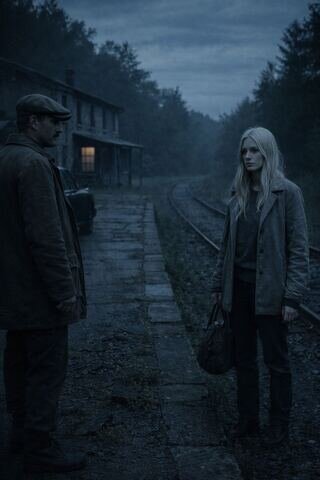
The car ride was long and mostly silent. Gravel replaced asphalt. The road narrowed. Forest pressed in from both sides. He did not ask questions. He drove steadily, as if the route were etched into him. She watched the dark gather between the trees and felt the last of the city fall away.
When they arrived, night had settled fully.
The caretaker led her through long corridors, footsteps muted, until a door stood ajar.
A library.
Dark wood paneling. An open fire that filled the room with warmth and shifting shadows.
He was sitting there.

Sunk deep into a worn armchair in front of the fire. Legs crossed. Completely at ease. As if time moved more slowly around him. A glass of cognac rested loosely in his hand. He did not rise. She stopped a moment too long.
Her gaze moved over him before she could stop it, slow and treacherous, as if her eyes were taking liberties she herself had not permitted. The beard stubble lay dense and dark against his skin, not unkempt but deliberate, sharpening the jaw rather than hiding it. The jaw itself was hard, unforgiving in its lines, shaped for authority rather than charm.
His forearms drew her eye with an almost physical pull. Coarse. Veins pronounced beneath the skin. Not excessively muscular, just undeniably strong, the kind of arms that carried weight without effort. Rolled-up sleeves sharpened the contrast between fabric and skin, between order and something rawer beneath.
His hands were worse. Large. Steady. Entirely certain of their place in the world. Fingers resting around the glass without tension, as if the grip never needed adjusting. Nothing nervous. Nothing searching. Only contained dominance. Hands that made decisions and expected them to stand.
Everything about him held together. The proportions. The weight. The way he occupied space without claiming it. This was not beauty seeking confirmation. It existed independently of the observer. It did not need her attention, yet held it.
It made her aware of her own body. Of the distance between them. Of how simple it would be to step closer, and how impossible it felt to do so.
He looked up.
For the first time, he held her gaze fully.
His eyes locked onto hers. The extreme lightness of them gave him pause. Ice blue. Almost colorless. Too clear. Too sharp. Not soft, not uncertain. For a fraction of a second, something shifted in his expression. Not surprise. Recognition. As if he had misjudged the depth of the water.
Then it was gone.
Control returned as cleanly as it had slipped. His face settled. The pause closed. Whatever had registered was already contained.
“Sit,” he said.
The word was quiet. Not an invitation. An instruction.
She obeyed before realizing she had decided to.
He took a sip of cognac. Let the silence settle.
“You will be responsible for the house,” he said. “The interior first. Order. Cleanliness. Meals at regular hours.”
He spoke without emphasis, as if the structure already existed and she merely had to step into it.
“The caretaker handles repairs and the grounds. You will coordinate with him.”
She nodded. Once.
“You will live on the second floor,” he continued. “Your room is prepared. Meals are taken in the kitchen unless instructed otherwise.”
She opened her mouth, then closed it again.
“You will have Sundays off,” he said. A pause. “Unless there is reason not to.”
Her eyes lifted despite herself.
“There will rarely be reason,” he added.
He leaned back slightly.
“Do you have questions?”
She searched for one. Found none that felt safe.
“No,” she said quietly.
A faint smile touched his mouth. Not warmth. Recognition.
“Good,” he said. “Then we understand each other.”
She did not know when it happened. Only that something shifted. A center of gravity moved. As if the floor itself had tilted, and she had adjusted without noticing. As if she had already stepped onto ground that sloped, and was only now realizing she was no longer standing quite straight.
4 Work
She began the next morning.
The caretaker showed her the kitchen first. No explanations beyond what was necessary. Where things were kept. What was expected. Then he left her alone.
The kitchen was large, orderly, worn by use rather than neglect. Stone floors. Heavy wooden surfaces. Drawers that slid with a familiar resistance, as if they remembered hands. She rolled up her sleeves and started with the obvious. Washed what had been left. Wiped surfaces. Opened cupboards one by one, not to rearrange, only to learn. What belonged where. What was missing. What had been abandoned halfway.
By midday the kitchen no longer felt hostile. Just quiet.
She was aware of him before she saw him.
Not a sound. No footstep. No clearing of a throat. Just the sensation of being measured.
He stood in the doorway. Not close. Not retreating. Watching.
He did not speak.
She kept working. Her hands knew what to do even as her attention narrowed. She could feel the weight of his gaze without looking up. It was not intrusive. It did not hurry her. It simply stayed. As if he were not evaluating the result, but the process.
By lunch she took a small break. A coffee and a sandwich on the steps by the entrance.
She sat with her back against the stone, knees drawn in slightly, the warmth of the house still clinging to her clothes. The coffee steamed faintly in the cool air. She drank it slowly, more for the pause than the taste.
From the steps she looked out over the garden.
It had once been shaped. That much was still visible. But the care had thinned. Grass grew unevenly, longer in some places, pressed flat in others as if walked without plan. Hedges sagged under their own weight, no longer trimmed, their lines soft and uncertain. Flowerbeds were hard to distinguish from the lawn, plants leaning into each other without order.
At the far edge, the garden did not end so much as give up.
The grass thinned and grew coarse. Moss crept in where soil had been exposed. Fallen leaves lay where no one had bothered to clear them away. Beyond that, the forest began. Not as a boundary, but as a slow claim. Trees stood close together, their shadows already thick, even in daylight. The air there seemed heavier. Still.
A narrow path cut through what remained of the lawn.
It was barely a path at all. Just a faint depression where feet had passed often enough to leave a trace. No gravel. No edging. It slipped away toward the trees without ceremony, half-swallowed by grass and weeds, as if it had been forgotten and continued anyway.
Her eyes followed it.
She felt it before she named it. A low pull. Not curiosity. Not yet. Something quieter. A sense that the path had existed long before she noticed it, and would remain whether she chose to follow it or not.
She tried to judge the distance. How far the trees were. How long it would take to walk there and back. The thought was practical, almost innocent. Her body reacted regardless. A slight tightening. A shift of attention, as if something had answered.
The garden was silent. No birds. No wind moving through the hedges. Even the house behind her seemed to recede, as though it had stepped back.
She took another sip of coffee. The sound felt intrusive. She swallowed quickly.
For a moment she imagined standing up. Stepping off the stairs. Letting her feet move without deciding. The image lingered longer than it should have.
She finished the sandwich, brushed the crumbs from her hands, and rose. The path remained where it was. Faded. Patient.
When she turned back toward the house, she did not look again.
In the afternoon she moved on to the living room. A formal space. Dark furniture. Surfaces that gathered dust easily. She cleaned with restraint. Polished without making things shine. Straightened without erasing age. Some rooms demanded less perfection than respect.
Again, she sensed him. Once near the window. Once by the fireplace. Always silent. Always still. Never close enough to force acknowledgment. Never far enough to disappear.
He did not thank her. He did not correct her. He let the work exist on its own.
She planned the evening meal early. Simple, solid food. Nothing ornamental. Something that belonged to the house. She worked steadily, chopping, stirring, tasting, adjusting.
When the meal was ready, she carried it to the dining room herself. Set the table. Placed the dishes carefully, evenly spaced. Straightened a napkin that did not need straightening. She did not look toward him, but she knew he was there. Somewhere behind her. Silent.
When she finished, she stepped back. Waited.
No comment. No instruction. No acknowledgment.
Then she returned to the kitchen.
Only after did she serve herself. A smaller portion. The same food. She ate standing at first, then sat. Alone. The absence of sound pressed closer than the walls. No radio. No ticking clock loud enough to anchor time. Just the house.
She wondered if he ate at all.
In the evening she cleaned once more, not because it was needed, but because it gave shape to the hours. When she finally went to her room, the corridors were empty. The silence followed her, unbroken.
Later, lying awake, she realized how complete the quiet was.
No distant traffic. No voices. No interruptions. The kind of silence that did not invite sleep so much as attention. As if the house itself were listening.
She thought of the city. Of noise she had once complained about. Of how quickly the absence of it had begun to feel heavier than its presence.
Downstairs, somewhere beyond walls and doors, he remained.
She knew this without knowing how.
And the night closed around the manor, dense and patient, holding its breath.
5 Nightmare
He went to bed later than usual.
The house had settled. The fires were banked. Doors closed. Stillness returned to its proper places. Yet his body refused it. Restlessness moved beneath the skin, small and insistent, as if something had been disturbed and not yet put back.
He lay on his back, hands folded loosely over his chest. The sheets were cool. Familiar. Usually enough. Tonight they offered no weight. His thoughts circled without landing. The day replayed itself in fragments. The sound of movement in the kitchen. The quiet certainty of her hands. The way she had not looked up. The way she had known when to stop.
His breath shortened. Then slowed again. Then shortened.
Eventually exhaustion took him. Not gently. Not fully. Sleep closed around him in uneven waves.
He was small again.
The kitchen was brighter than it should have been. Morning light too sharp. The smell of burnt food thick in the air. His mother stood by the stove, shoulders drawn in, hands useless at her sides. The pot was blackened. Smoke curled upward.
“I’m sorry,” she said. Too quickly. Too often.
His father stood behind her. Close. Too close. His voice was low. Controlled. The kind that did not need to rise.
The first slap came without warning. A flat sound. Her head snapped to the side. She did not fall. She never fell. Another followed. Then a shove that sent her against the counter. She caught herself with her hands, shaking.
“I’m sorry,” she said again. Quieter. As if volume were the problem.
The boy stood frozen. Bare legs in short trousers. The floor cold under his feet. He felt something move in his chest. Not fear. Not yet. Something tighter. Denser.
His father’s anger did not flare. It pressed. Silent. Heavy. Worse for it.
The boy ran.
Out the door. Into the trees. The forest swallowed him whole. Branches tore at his skin. He stumbled. Fell hard. Pain flared bright in his knee. Blood warm, running. He did not stop. He cried without sound, breath tearing out of him, face burning as spruce needles lashed his cheeks.
He ran until the ground changed.
A clearing.
Seven stones stood there. Upright. Uneven. Set in a ring. Old moss clung to them, thick and dark, swallowing their edges. The light thinned. Sound dropped away. Even his breathing seemed wrong here.

He stopped in the center.
The forest leaned in.
The stones made a sound.
Not a voice. Not words. A pressure. A low vibration that moved through the ground, through bone, through the place where his fear had been forming. It held him. Quieted him. Wrapped around the rage he did not yet know how to name.
He sank to his knees.
The dark deepened. The sound grew closer. Inside him now. The pain in his knee dulled. The crying stopped. Something else took its place. Something still. Something watching back.
And the dream did not end.
It only settled.
He woke with a jolt.
The sheets were cold against his skin. His shirt clung to his back, damp, the fabric already cooling. Sweat slicked his chest and neck, a thin, unforgiving film. His heart beat too fast, uneven, as if his body had not yet accepted that the dream was over.
The room was dark. Familiar. The bed where it had always been. The ceiling lost in shadow. No forest. No stones. And yet the pressure remained, heavy in his chest, as though something had followed him out of sleep.
He lay still and listened.
The manor answered with its particular silence. Not empty. Never empty. A faint settling of wood. The distant, patient breath of the building itself. It held him where he was.
His hands trembled once before he forced them still. He drew a slow breath, then another. The chill of the sheets crept into him, but the heat of the dream did not release its hold. Images lingered behind his eyes. The kitchen. His mother’s voice. The sound the stones made, still too close, too intimate.
He sat up.
Sweat slid down his temples. He dragged a hand over his face, felt the roughness of his stubble, the undeniable proof of now. Here. Awake. Even so, his body refused to fully return. It clung to something older, something that did not obey order or time.
After a moment he stood and crossed the room barefoot. The floorboards were cool, grounding him just enough. He stopped by the window without pulling the curtain aside. There was nothing to see. He did not need it.
They slept on the same floor.
The knowledge came unbidden, precise. The long second floor stretched between them, rooms laid out like a deliberate distance. She was at the far end of the corridor. Another wing. Another silence. Close enough to feel. Too far to touch.
He could picture the space between them. The doors. The darkened passage. The way sound would travel if it chose to. He did not wonder whether she was asleep. Or awake. It did not matter. Her presence was there regardless. A subtle shift in the balance of the house. An added weight.
He stood until his heartbeat slowed, until the rhythm returned to something usable.
When he lay down again, sleep did not come to claim him.
It did not need to.
It waited.
As the manor always had.
As the stones had, long before him.
6 The old housekeeper
The old housekeeper did not leave at first.
She stayed for the mistress of the house.
For the hours after the shouting stopped. For the quiet work that followed violence. She learned how to cool swelling, how to clean blood from skin and fabric without leaving a mark. How to touch wounds without asking questions that could not be answered. The mistress never spoke of the blows. She did not need to. Her body carried the truth plainly enough.
Then one morning the mistress did not come down.
They found her alone. Too still. The house absorbed it without protest. Doors were closed. Curtains drawn. The death was called sudden. It was anything but.
The boy was small then.
Too small to understand why his mother was suddenly gone. Old enough to understand that something had ended. What little restraint the father had once kept disappeared entirely. The house tightened around him.
The beatings began to change.
Not in frequency. In intention.
The belt was taken off deliberately. Folded once. Twice. The sound came first. A warning that was worse than surprise. The boy learned to stand still. To keep his hands at his sides. To make no sound. Pain came anyway. The body learned before the mind could. Learned how to wait for it to end.
Afterward, the father would leave the house.
He did not look back.
He walked straight toward the forest, his steps heavy and certain, as if called. The housekeeper watched from the doorway more than once, the boy crouched somewhere behind her, shaking without crying. The man entered the trees and was swallowed quickly. As though the woods had been expecting him.
Each time, the birds went more and more quiet.
Not all at once. Not dramatically. One by one. A thinning of sound. A pause that stretched too long. The forest did not echo. It listened.
The housekeeper stayed.
For the boy, now truly alone.
But there was only so much she could shield. And when the decision came, it came quickly and without discussion. The boy was sent away. Boarding school first. Then farther still. University. Distance dressed up as opportunity. Silence mistaken for safety.
She remained behind with the old man.
She stayed as his body failed and his power dwindled. As his voice weakened but never softened. She cooked, cleaned, waited. Watched death take him slowly, as it prefers to do in that house. When it was over, she closed his eyes herself. Stayed a while longer, because the walls did not loosen their grip just because one master was gone.
Years passed.
When the young man returned, grown now, educated elsewhere, carrying polish over fracture, she stayed for him too. Helped him into the role that had been waiting. Showed him what the house required. What could be neglected. What must never be disturbed. She told herself she was steadying something dangerous simply by remaining.
But she watched the house accept him.
Not violently. Not openly. Control settled into him the way damp settles into stone. Quiet. Inevitable. The boy disappeared completely. The man took his place. Parentless still, but no longer unclaimed.
When he turned thirty-eight, she understood that the moment had passed.
The darkness moved again. From corners. From the forest. The stones stirred in the old way. People whispered of witches, pale figures seen where the trees thinned. She had heard it all before. She knew when listening was wiser than disbelief. The manor demanded its sacrifice.
Her sister’s illness gave her the excuse she needed. Real enough to be spoken aloud. Insufficient to explain the urgency.
She left quickly.
Not because she no longer cared. Because staying any longer would mean choosing the house over herself. Over whatever years remained to her.
She felt shame for leaving him. A grown man this time. Capable. Grounded. And yet still bound to a place that did not loosen its grip.
She was glad to be free of the manor’s power. Glad to breathe air that did not remember her hands. Glad to sleep without listening for sounds that never came.
Both things were true.
And she carried them together, knowing some debts are not paid by staying, and others are not forgiven by leaving.
7 Sunday
The house did not reveal itself all at once. It resisted being taken in as a whole. Each room required its own attention, its own adjustment. Dust lay thickest where light reached least. She wiped surfaces with care, lifting rather than spreading it. The smell of old wood, wax, and fabric settled around her, steady and grounding.
The floors demanded patience. Wide planks, darkened by age, marked by decades of movement. Some boards bore deeper wear, others responded sharply to polish, catching light where they had not in months. She worked on her knees for long stretches, arms burning, back stiff, but the effort felt clean. Necessary. The scent of wax rose slowly, and with it something like order.
The house noticed.
It was not immediate. But by the time she moved to the next room, the one behind her felt altered. Less resistant. As if it accepted what she had done.
At one point she paused in a corridor, cloth in hand, listening. The house had its own language. Soft creaks. A distant shift of weight. A door somewhere above. She learned to distinguish what belonged to the building from what belonged to people.
Later that day, she encountered the doors.
They protested her movements with long, strained sounds. Hinges complained. Frames resisted. She slowed, adjusted her grip, tried different angles. Some doors softened. Others refused. She made a note of them mentally, then mentioned it to the caretaker when she saw him near the back stairs.
He listened without interrupting. Said he would take care of it.
When he returned, he carried oil and tools. He worked carefully, testing each hinge, adjusting pressure rather than forcing compliance. She watched briefly, then returned to her work. By the time she passed those doors again, they opened with a subdued sound, not silent but no longer accusing.
She saw the Master for the first time since their first encounter from a distance.
He crossed the far end of the corridor while she polished near the entrance. He did not slow. Did not look at her directly. Or if he did, it left no mark. His presence altered the air briefly, then withdrew. She stood still until he passed, then resumed her work without comment.
She noticed, later, that her hands were steady.
As she moved through the rooms, she learned their hierarchies. Some were meant to be passed through. Others to be inhabited. The dining room carried weight despite its emptiness. Only one place was ever set. The chair at the head of the table bore signs of long use. The floor beneath it was more worn than the rest. She polished around it carefully, preserving its position.
She adjusted small things without instruction. A rug shifted a fraction back into alignment. A frame straightened by a degree barely perceptible. Curtains opened fully in rooms where light had been rationed too long.
No one told her to do these things. No one stopped her.
Meals were taken in the kitchen. Sometimes alone. Sometimes with the caretaker. Conversation was sparse but functional. He asked where she was from. She answered. He asked if she was settling in. She said yes. That was enough.
She noticed the way he moved through the house. Respectfully. As if aware of boundaries not marked by walls.
At another point, she heard footsteps on the stairs. The Master again. This time closer. He passed through the hall while she worked near the threshold, cloth pressed to the floor. She rose slightly, waiting. He did not speak. Did not gesture. The silence stretched, then released as he moved on. She returned to her task, the wax catching light where her hand had just been.
The following day, the house felt different.
Not cleaner. More aligned. Sound traveled differently. Her footsteps softened. The echo diminished. The rooms no longer felt as though they were watching her work. They allowed it.
She worked through the morning room next. Light entered there at an angle that revealed imperfections quickly. Dust lifted easily. She opened the curtains fully and left them that way. When she finished, the floor reflected the window in broken lines. The room felt awake, as if it had been waiting.
She caught her reflection briefly in the glass. Smaller than the room. Present, but not dominant. She turned away without lingering.
Later, from the garden path through a window, she saw the Master standing in the library. He was still. Glass in hand. Fire lit despite the mild air. He did not move. She did not watch long enough to be noticed.
The work continued.
By the time she finished the first floor, it felt complete in a way she could not have described before. Not restored. But coherent. The house no longer resisted her presence. It had accepted her rhythm.
She was told, simply, that the next day was hers.
The caretaker mentioned it over breakfast. Stated it as fact. Suggested she take one of the bicycles if she wanted. There was a town not far away. Shops. A church.
She hesitated only briefly.
The bicycle was old and heavy, but sound. She adjusted the seat, tested the brakes, then set off down the road that led away from the house. The forest closed around her again, but this time she moved through it under her own power. The road rose and fell gently. Her legs burned. The air filled her lungs. The movement felt necessary. Like proof.
The forest thinned gradually. Fields opened. The town appeared without ceremony. A square. A general store. A café. The church stood slightly apart, stone darkened by age.
She locked the bicycle and walked.
The church door was open. Inside, the air was cool. Sparse. She sat near the back and waited. Voices gathered. Hymns began, sung more from habit than devotion. She did not sing. She listened.
Afterward, people lingered.
She felt their attention before they spoke. Glances. Pauses. Conversations that slowed as she passed. Someone approached her with a polite smile. Asked her name. Where she was staying. Whether she was new.
She answered simply. She worked at the manor now. She had arrived recently.
The name altered everything.
Interest sharpened. Questions grew more specific. Someone mentioned the previous housekeeper. Another asked how the Master was managing alone. A third leaned in slightly, lowering their voice, asking if the stories were true.
She felt something tighten in her chest.
She said she did not know. That she was new. That she was there to work. She did not speculate. Did not repeat what she had heard. The disappointment in their faces was immediate.
She realized, then, that she felt protective.
She had not spoken to the Master. Had not been acknowledged directly. And yet the way his name was handled, passed between mouths, unsettled her. She felt an instinctive resistance to it. A loyalty that surprised her in its immediacy.
She left soon after.
The ride back felt shorter. The forest closed around her again. The manor appeared ahead, unchanged, waiting.
When she returned, the caretaker was working near the outbuildings. He nodded when he saw her. Asked if the ride had been good. She said yes.
That evening, she ate alone. The house was quiet. Settled.
She thought about the rooms she had cleaned. The doors that no longer complained. The floor that reflected light again. She thought about the questions outside the church. The lowered voices. The way she had answered without hesitation.
She understood that she had chosen a side without being asked.
She heard, the Master moved through his routines as he always had. He noticed the floor. The air. The way sound carried now. He noticed the absence of resistance.
He said nothing.
The house, however, had begun to respond.
8 The cut
A few days passed after her visit to the town before the equilibrium fractured.
The afternoon had settled into a steady, almost meditative rhythm. Sara stood at the sink in the kitchen, sleeves rolled, washing the lunch dishes one by one. Plates. Cutlery. A heavy pan she lifted with both hands. The window was cracked open just enough to let in air. Light slid across the surface of the water and broke apart on porcelain. Outside, the sound of chopping had been constant for some time. Wood meeting iron. Controlled force. A practiced cadence that had become part of the house’s background, as familiar as the ticking of an old clock.
She noticed the rhythm more by its absence than its presence.
The sound faltered. Not dramatically. Just enough.
Then it stopped.
She stood still, hands submerged, listening. The pause stretched past what felt natural. Her body responded before her thoughts aligned. She dried her hands quickly, left the towel folded wrong on the counter, and turned toward the door.
He entered the kitchen without haste.
That, more than the blood, was what unsettled her.
His movement was controlled, deliberate, as always. But his posture had shifted, subtly pitched forward, as if his body had decided something his mind had not yet addressed. One leg dragged a fraction behind the other. Dark red had already soaked through the fabric of his trousers, spreading downward in a slow, undeniable bloom.
He crossed the room and sat down heavily on one of the kitchen chairs. The wood creaked under his weight. Only then did he look at her.
“I slipped,” he said.
The words were neutral. Informational. As if reporting weather.
For a split second, she only stared. Then she moved.
“Don’t move,” she said, already opening drawers, already reaching for linen cloths, for the bowl she filled with warm water.
He did not respond. Did not object. He rested his forearms on his thighs, hands loose, shoulders squared. His breathing was even, controlled, but she saw the tension along his jaw, the way his teeth pressed together briefly and then released.
She knelt in front of him.
The position was unavoidable. The kitchen chair was low. There was no other way to reach the wound properly. She became aware of the heat radiating from him, of the solid presence of his legs framing her field of vision. The smell of iron reached her as she lifted the wet cloth to his skin.
The cut was worse than it had looked from a distance. The axe had glanced off course, slicing along the side of his lower leg just below the knee. The wound was open, the edges raw. Blood welled steadily, but not violently. Deep enough to demand attention. Shallow enough to spare him permanent damage.
She pressed the cloth gently against the wound.
His breath caught. A single sharp inhale that he did not try to disguise.
Her hands steadied instinctively. Firmer now. More precise.
“I’m going to clean it,” she said, her voice quieter than before.
“Do it,” he replied.
She worked carefully, rinsing the cloth, returning to the wound, watching the water cloud red and then clear again. Her fingers were sure. She had done this before, on herself, on others, small accidents and kitchen cuts. But never like this. Never with someone who filled the room simply by sitting in it.
The kitchen seemed to contract around them. The ordinary sounds withdrew. The faint drip from the tap became loud. She was suddenly aware of the space between breaths. Of the weight of silence.
She felt his attention settle on her.
Not abstract. Not distant.
Focused.
When she looked up, their eyes met.
It was not a glance. It was contact.
His eyes were darker at this distance. The blue deepened, edged with violet where the light failed to reach. They were steady, unblinking, fixed on her with an intensity that did not waver. She felt it immediately, low in her body, a slow pull rather than a jolt. As if something in her had been recognized without being named.
She had the sudden, disorienting sense of being seen not as she presented herself, but as she was. Small. Contained. Quiet. And yet entirely present in that moment, kneeling between his legs with her hands on his body.
The sensation unsettled her, but it did not frighten her.
She did not look away.
For him, the moment landed with unexpected force.
He had intended to sit, to allow her to tend the wound, to leave the room and resume control. That was the order of things. Injury was an inconvenience, nothing more. Pain was manageable. He had known worse.
But when she lifted her gaze to his, something shifted.
He had seen her before. Passing through corridors. Bent over floors. Silent, efficient. A presence that altered the house without demanding recognition. He had registered her competence, her precision. He had approved of the way the rooms responded.
This was different.
At this distance, he became acutely aware of her stillness. The way she did not fidget. The way her hands were steady not because she forced them to be, but because steadiness came naturally to her. He noticed the pale line of her throat when she swallowed. The clarity of her eyes, ice blue, almost translucent, ringed with a darker edge that held his gaze in place.
She did not flinch under his attention.
That, more than anything, unsettled him.
Most people shifted when he looked at them. Adjusted. Filled the silence with words or gestures. She did neither. She simply held his gaze, as if this exchange required no commentary.
Pain registered dimly, somewhere at the edge of his awareness. The real sensation was elsewhere. A low, unfamiliar tension that gathered in his chest and moved downward, slow and controlled, demanding acknowledgment without offering release.
She felt it too.
She felt the weight of his gaze like pressure rather than heat. As if he were testing her balance, her resolve, without moving a muscle. Her breath slowed. Her body anchored itself instinctively. She became aware of her knees against the stone floor, of the warmth of his skin beneath her fingers, of how close she was to the center of him.
Her hands did not shake.
She cleaned the wound thoroughly, then reached for fresh linen and bandage. As she wrapped it, her fingers brushed his skin more than strictly necessary. Not carelessly. Not deliberately. Simply because the space between them had narrowed to something unavoidable.
Each brief contact sent a quiet current through her. Not sharp. Not overwhelming. Steady. Insistent.
When she tied the bandage, she lingered a fraction of a second longer than required, fingers firm against his leg.
Neither of them spoke.
When she finally sat back on her heels, the distance between their bodies increased slightly, but the connection did not loosen. The air between them felt charged, stretched taut.
“You’ll need to keep it clean,” she said at last, her voice controlled, professional. “I’ll change it later.”
He nodded once.
“Thank you.”
The words were simple. But they carried weight.
It was the first time he had addressed her directly since her arrival. The first acknowledgment that passed between them without intermediaries, without the buffer of corridors or routine.
She rose slowly, aware of her body again, of the faint tremor that had begun in her legs only now that the immediate task was complete. She turned away, retrieved clean trousers, and placed them on the table beside him. He stood once she stepped back, careful, controlled. The movement reasserted his physical dominance, the way he filled the space effortlessly. But now it was layered with something else. An awareness that lingered beneath the surface.
When he left the kitchen, the door closing softly behind him, the room did not immediately return to normal.
Sara remained where she was for a moment longer than necessary, staring at the sink, at the water still swirling faintly red before clearing. She washed her hands slowly. Thoroughly. The tremor subsided.
Outside, the sound of chopping did not resume.
Later, when she changed the bandage as promised, the wound had begun to close. Less blood. Cleaner edges. He sat again, composed, his attention restrained now, contained. Their eyes met only briefly this time. Their hands did not touch beyond necessity.
But the shift remained.
It did not demand words. It did not require action.
It had been acknowledged.
That night, in her small room, Sara lay awake longer than usual. The moment returned unbidden. The way his gaze had held hers. The pull that had followed. She did not analyze it. Did not label it. She allowed it to exist as it was, unresolved, present.
Downstairs, the Master sat alone, leg elevated, the glass beside him untouched. He replayed the scene with the same precision he applied to everything else. Her steadiness. Her silence. The way she had met his gaze without retreat.
He did not smile.
But he understood that something had entered the house.
And it was not leaving.
9 Desire
The weeks settled into the house like dust. Slowly. Quietly. With a patience she had not expected.
By the time this rhythm took hold, the first floor was already finished. The kitchen no longer smelled of old grease and scorched metal. The sink held light instead of residue. The hall had regained its shape, the stone floor pale again beneath years of grime. Downstairs had yielded to her through repetition. Through insistence. It no longer resisted her presence.
Upstairs was different.
The second floor carried weight. Not just physical, but accumulated. The ceilings pressed lower. The corridors narrowed slightly, as if drawing inward. Doors resisted being opened, their hinges stiff with neglect and something else. Memory, perhaps. These rooms had not emptied themselves willingly. They had been sealed in grief, shut with intention.
She chose one room at a time.
Anything more felt like intrusion.
She began each morning upstairs by opening a window, even when the air was cold. The sound changed immediately. Wind moved through the hallways, cautious at first, then more freely. Dust lifted and drifted, reluctant to settle again. The smell shifted. Less stagnation. More linen. Old wood. Something faintly floral that clung stubbornly to the walls.
She worked slowly. Carefully. As if the rooms might recoil if she moved too fast.
She folded sheets that smelled faintly of old soap, the kind no one used anymore. Straightened chairs no one had sat in since the funeral. Ran her fingers along the spines of books she did not open. She wiped surfaces without erasing everything. Some things felt untouchable. Others demanded it.
In one bedroom, the curtains were still drawn. She pulled them back inch by inch, letting light strike the bedframe, the dresser, the floor. The dust rose like breath held too long. She stood very still until it settled.
In another room she found a mirror turned toward the wall. The frame was thick with dust. She cleaned the wood carefully, tracing its edges with the cloth. When she reached the glass, she stopped. Left it hidden. Turned away without questioning why.
The house watched her more closely here.
She felt it in the way the air changed when she entered a room. In the way floorboards sighed under her weight, slower than downstairs, heavier. She worked until her shoulders burned, until her wrists ached, until the rooms softened just enough to allow her presence without protest.
Each evening she returned to her small room exhausted in a way that surprised her. Not just physical. As if something unseen pressed against her ribs all day long and released her only when she closed the door behind her. She lay on the bed listening to her own breathing, waiting for it to slow.
That was when she began to listen for him.
She learned his rhythms without seeing him. The way his steps sounded heavier at dusk. The pause outside the library, always the same length. The low murmur of his voice when he spoke to no one, words indistinct but controlled. Sometimes the house creaked beneath his movement, answering him in a way it never answered her.
His presence began to seep into her thoughts.
Not as an image at first. As pressure. Heat. A disturbance that made it harder to concentrate. She would catch herself standing still in an upstairs bedroom, cloth forgotten in her hand, heart alert for no reason she could name.
She noticed the spaces he occupied by their absence when he left them. The library after dark. The stairwell just before evening. She learned where not to linger, and where she lingered anyway.
He noticed her too.
Not directly. Not yet. But something in him shifted. He felt it most clearly in sleep.
His dreams came thick and tangled. In them, she appeared without warning. Bent over a bedframe, smoothing sheets with slow, deliberate movements. Kneeling by an open window, sleeves pushed back, wrists exposed. Standing on the landing, half-lit, looking at him as if she already knew something about him he had never allowed himself to see.
The dreams were erotic, but not clean. Desire braided itself with unease. Her presence stirred a hunger he did not name. He woke tense, breath shallow, the sense of her skin lingering too close, as if the dream had pressed itself into his body.
Other nights the dreams turned darker.
His father’s hands. The sound of a belt pulled free, leather whispering through air. His mother’s voice, thin with pain, then silent. The way he had learned to stand very still as a boy, listening from the stairs, counting his breaths so he would not be heard.
In these dreams, the house watched. Walls leaned inward. Doors refused to open. He woke sweating, jaw clenched, the memory lodged in his body like a bruise that never quite healed.
By morning, he avoided her.
She felt the change immediately. The silence sharpened. His steps retreated. Doors closed more firmly. The house seemed to hold its breath, as if waiting to see who would yield first.
She worked harder upstairs. Longer. As if effort alone could draw him back into proximity. She cleaned deeper into corners she had avoided. Opened drawers she had left untouched. The rooms grew brighter, barer. Less guarded.
She began to look for him without meaning to.
A pause on the landing. A glance down the stairwell. Listening for him in the evenings. Timing her movements so she might hear his door open, his steps below. When she did, her pulse quickened, sharp and unwelcome.
She did not speak to him. Not yet. But she allowed herself to look.
His hands. Scarred. Controlled. The way he held himself as if tension were permanent, as if release were dangerous. She sensed something tightly contained beneath his stillness. Something that recognized her attention and recoiled from it at the same time.
The longing grew between them without words.
It filled the rooms she had cleaned upstairs. Settled into the newly aired spaces. Pressed itself into the walls, into the floors, into the narrow corridors that connected them.
Neither of them understood yet what the house was preparing to give back.
10 The kitchen disaster
Late afternoon moved slowly through the kitchen.
The light had shifted from bright to slanted, no longer generous, more selective. It entered through the tall windows in narrow bands, catching on dust in the air, resting briefly on the worn surface of the wooden table before sliding away. The house seemed to exhale with it, settling into that suspended hour between day and evening, when nothing yet demanded to be finished.
Sara worked quietly.
She had taken her time with the meal, not out of confidence but caution. Each movement was measured, almost rehearsed. She washed the herbs twice, her fingers numbing in the cold water, then laid them carefully on a cloth to dry. Thyme. Parsley. A few fragile sprigs she did not know the name of, gathered from the sheltered side of the outer wall where the wind rarely reached. She chopped slowly, listening to the steady knock of the knife against the board, letting the rhythm calm her.
The kitchen smelled faintly of raw vegetables and old wood. Beneath it lingered the deeper scent of the house itself. Stone. Dust. Something that had been closed for too long.
She set the pan on the stove and added butter, watching it melt. Pale yellow turning translucent, then foaming softly. The sound comforted her. Alive. For a moment she allowed herself to believe that this simple act might anchor her there, that cooking could make her part of the house rather than a presence moving through it.
Her thoughts drifted.
She imagined the evening as it could be. The table set with care. Plates warmed. A quiet meal eaten without tension. She imagined him sitting across from her, composed, distant but present. Imagined a look from him that signaled approval rather than scrutiny. The fantasy was small, almost naive, but it warmed her chest.
Then it slipped away.
She added the herbs.
Too soon.
The butter darkened faster than she expected. The foam collapsed in on itself. A sharp, acrid note cut through the air. She blinked, dragged abruptly back into her body. The smell reached her a second later, unmistakable and wrong.
Burnt.
Her heart dropped.
She stirred quickly, as if speed might undo chemistry. The herbs clung to the pan, darkened, brittle. Smoke rose in thin, accusing threads. She turned down the heat and opened the window wide. Cold air rushed in, stinging her fingers, but the smell did not retreat. It spread instead, crawling up the walls, slipping out of the kitchen like a rumor.
She stood very still.
A familiar tightness settled in her chest. Not panic. Anticipation. The quiet dread of having failed at something simple. Of having disturbed a fragile order she did not fully understand.
She should have scraped it out. Started over. She knew that.
But she hesitated.
For a second too long.
The smell deepened.
Upstairs, it found him.
He registered it before his mind assigned meaning. His body reacted first, tightening, alert. The scent folded time inward. Heat gone wrong. Carelessness punished. His hand stilled on the paper in front of him.
He was no longer fully in his office.
He was back in a narrow kitchen where voices rose without warning. Where his mother stood too still. Where heat and anger lived side by side. He remembered the way his father’s body filled space. The way objects became excuses. The sound of a blow landing where it should never land. The silence afterward, thick and absolute.
His jaw tightened.
He hated that man. Hated the power. And learned it anyway.
When he left his office, he already felt dangerous.
Downstairs, Sara finally moved again. She scraped the pan, the sound harsh in the quiet kitchen. Her hands were slightly unsteady. She told herself it was nothing. Just food. Just a mistake.
But the house was already carrying it.
She heard his footsteps before she understood them. Her body reacted first. Something inside her gave way slightly. Her knees softened. Her breath shortened. She straightened instinctively, as if posture might protect her.
She did not turn around.
He stopped in the doorway.
The smell hung thick between them.
He crossed the room quickly.
She felt him at her back, the air tightening, her weakness turning sharp and humiliating. She gripped the counter to steady herself, shame rising fast and hot. Then she turned around to face him.
He reached past her and turned off the stove with unnecessary force.
The click was sharp. Final.
Then the space disappeared.

Her back met the cold zinc sink. The shock pulled a breath from her. He was close enough that she felt the heat of him, the density of his body, the certainty of his position. He did not touch her, but the restraint itself pressed against her like weight.
For a moment, anger surged through him.
The position was wrong. Too familiar. His father had stood like this. Cornering. Looming. The memory slammed into him with sickening clarity. His mother’s eyes. Not defiant. Not pleading. Just resigned. The knowledge that this was how things went.
Something ugly stirred. A reflex. A pattern.
Then Sara looked up at him.
Her ice blue eyes were wide, frightened, but open. There was regret there, immediate and raw. Not fear of punishment, but fear of having disturbed something precious. Of having disappointed him. The vulnerability in her expression cut through him.
He felt disgust with himself.
And then, just as swiftly, desire.
It horrified him how easily the anger turned. How the same energy shifted direction instead of disappearing. Heat flooded his body, slower now, deeper. A pull that was both physical and psychological. The awareness of her size against him. Her softness. The fact that she was trapped not because she was weak, but because he was choosing to hold the space. He wanted her.
Sara felt the shift with terrifying clarity.
She had never felt anything like this.
The attraction hit her low in the body, heavy and dizzying. It was not romantic. It was not safe. It was threaded with submission she did not recognize in herself. With fear that sharpened rather than repelled. With shame at how her body responded when her mind told her it should not.
Her knees threatened to buckle again.
She hated that she wanted this. Hated the way part of her leaned toward him, aching for him to close the distance. The desire felt indecent, exposed, as if he could see straight through her. She wanted him to kiss her with a desperate intensity that frightened her. Wanted the tension to break. Wanted the choice taken from her so she did not have to own it.
He leaned in.
Not to kiss.
He breathed her in instead, slowly, deliberately. Her scent grounded him and undid him at the same time. Soap. Smoke. Warm skin. His beard brushed her throat, rough enough to remind her of his presence, controlled enough to remind him of his restraint.
Her breath stuttered. Her hands trembled. Shame burned alongside desire.
For a suspended second, he considered it.
The kiss would have been easy. Inevitable. A release. A start. He could see that she wanted it too. The air between them had become electric. He wanted to own her. Dominate her. Take her right then and there. A kiss would have been the start of something he could not stop.
Then he saw his father again. Saw the line where power became violation. Where desire turned into justification.
Footsteps sounded in the hall.
Measured. Familiar. The caretaker’s steady pace, keys chiming softly.
The moment shattered.
He pulled back at once, as if burned. Control snapped into place, rigid and absolute. His face emptied. The man she had almost kissed vanished behind a mask she could not reach.
Sara straightened too quickly, humiliated by the weakness still trembling in her legs. She kept her eyes down. Kept her desire hidden. Kept her shame to herself.
When the caretaker entered the kitchen, the space between them was once again safe.
And unbearably charged.
The smell of burnt food lingered long after everything else had been swallowed by silence.





















0 Comments